
Grab’s Fintech Business

Grab’s fintech business is infrastructure, not upside. Lending, payments, and ads stabilize drivers and merchants and narrow valuation errors.
In this article
Grab’s Fintech Business Is Not the Upside. It Is the Load-Bearing Layer.
Why Grab’s financial services arm exists to stabilize the platform, not to drive valuation, and why mistaking the two leads to persistent mispricing.
Grab Fintech Is Not a Growth Story. It’s a Systems Problem.
Fintech is where most Grab analyses start to drift.
Once investors accept that ride-hailing and deliveries in Southeast Asia operate under structural pricing and labor constraints, attention shifts almost automatically to financial services. Payments. Lending. Digital banking. The logic feels intuitive. If the core platform is capped, fintech must be where the upside lives.
That framing misses why Grab built fintech in the first place.
Grab’s financial services segment was not designed to become the primary profit engine of the business. It was built to solve liquidity and coordination problems inside a platform that depends on millions of drivers and merchants operating with thin financial buffers across fragmented banking systems.
Grab’s valuation continues to carry an embedded assumption that its financial services segment represents upside optionality in the way early-stage fintech platforms often do. Payments, lending, and digital banking are treated as future profit engines that could meaningfully re-rate the business if execution improves or scale accelerates.
That framing misses the role fintech actually plays inside a superapp operating under Southeast Asian constraints.
Grab is no longer a company searching for a second act. It is a scaled platform with durable demand, visible regulatory exposure, and a balance sheet that already reflects survival rather than speculation. In that context, fintech does not exist to transform the earnings profile. It exists to make the rest of the platform work more reliably.
The valuation error comes from importing bank or standalone fintech logic into a system where financial services are structurally subordinate. Credit, wallets, and payments are embedded inside mobility and commerce flows that are price-sensitive, labor-constrained, and politically visible. That positioning limits how aggressively fintech can be monetized without destabilizing the core business.
The result is a persistent disconnect. Investors debate fintech upside as if it were additive, while the company manages it as infrastructure. That difference matters. It determines how much capital the segment is allowed to absorb, how risk is managed across cycles, and how much of its contribution should be capitalized in a long-duration valuation.
This distinction is the foundation for how fintech should be analyzed inside Grab. Before asking what it can earn, it is necessary to understand what it is designed to support.
What Fintech Actually Does Inside Grab’s Ecosystem
Grab’s financial services segment exists to solve coordination problems created by operating a labor-intensive, price-sensitive platform across fragmented financial systems. Its role is functional. It reduces friction, stabilizes supply, and improves monetization efficiency elsewhere in the ecosystem.
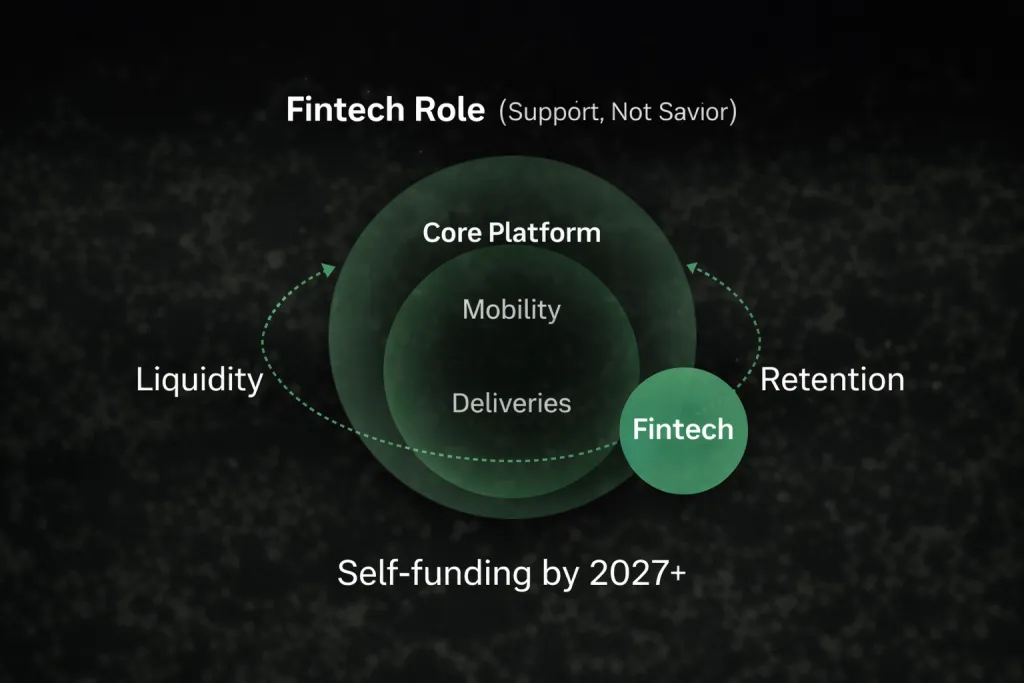
The first job is payments reliability. Grab operates in markets where card penetration, settlement speed, and transaction failure rates vary widely. Embedded wallets and payment rails reduce friction at the point of transaction, shorten settlement cycles for merchants and drivers, and improve completion rates across Mobility and Deliveries. This shows up indirectly in GMV retention and order frequency rather than as a standalone revenue line.
The second job is supply stability. Drivers and merchants operate with thin liquidity buffers. Short-term credit, float access, and faster payouts reduce churn and smooth participation during demand fluctuations. This matters operationally. In Q3 2025, Grab reported continued growth in monthly active drivers alongside rising transactions per driver, even as incentive intensity remained controlled. Fintech support reduces the need for blunt incentive spend by making participation economically viable during slower periods.
The third job is merchant monetization support, where fintech and advertising intersect. Grab’s advertising layer depends on merchants having the liquidity and confidence to spend consistently. Faster settlements, embedded payments, and working capital access allow merchants to reinvest in sponsored placements without pulling back during short-term volatility. This matters because advertising is now a measurable contributor to Deliveries profitability.
By Q3 2025, advertising penetration had reached approximately 1.7% of Deliveries GMV and held steady across multiple quarters. Quarterly active advertisers reached roughly 228,000, while average spend per advertiser continued to grow year over year. That spend is more stable when merchant cash flow is predictable. Fintech supports that stability indirectly, without requiring fee increases or higher commissions.
The fourth job is data coherence. Payment flows, repayment behavior, and merchant transaction histories improve underwriting, ad targeting, and incentive calibration across the platform. This data advantage feeds back into efficiency rather than revenue maximization. It improves return on ad spend for merchants, reduces credit losses over time, and allows Grab to fine-tune pricing and incentives without triggering regulatory or competitive responses.
What matters is how these jobs aggregate. Financial services does not need to generate high standalone margins to create value. Its contribution appears through lower incentive intensity, steadier advertiser demand, higher utilization, and improved operating leverage elsewhere in the platform.
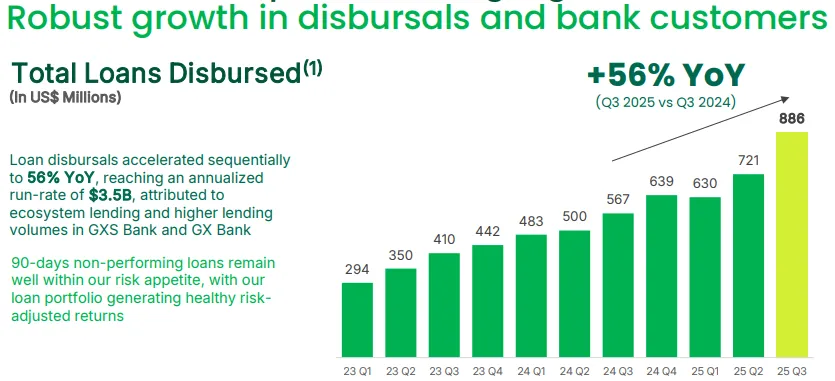
This framing also explains the reported losses. In Q3 2025, Financial Services recorded an adjusted EBITDA loss of approximately $28M, driven largely by credit provisioning as lending scaled. Those losses reflect the cost of building infrastructure under real credit exposure. They are not evidence that fintech is failing. They are evidence that it is being used.
Understanding fintech at this level clarifies why Grab manages it conservatively. The segment exists to support the platform’s core economics. Its success is measured by how little disruption it introduces, not by how loudly it advertises upside.
Why Credit Exposure Caps How Fintech Can Be Valued
The moment fintech introduces credit risk, its valuation ceiling changes. Inside Grab, that ceiling arrives quickly.
Unlike payments or wallets, lending imports cyclicality into a platform whose core businesses are otherwise volume-driven and operationally predictable. Credit losses do not scale smoothly. They arrive in steps, tied to macro conditions, underwriting accuracy, and regulatory posture. That volatility is manageable when fintech remains a support layer. It becomes destabilizing when it is capitalized as a profit engine.
This is the core reason bank-style valuation logic breaks inside a superapp. Traditional fintech narratives assume expanding return on equity as loan books scale and fixed costs are absorbed. Grab operates under a different mandate. Credit exists to stabilize drivers and merchants, not to maximize spread. That changes risk appetite, pricing behavior, and growth discipline.
The financials make this visible. In Q3 2025, Financial Services recorded an adjusted EBITDA loss of approximately $28M, driven primarily by credit provisioning as lending volumes increased. Provisioning is not a one-time build cost. It is the price of operating through cycles. As credit exposure grows, provisioning becomes a recurring governor on profitability rather than a temporary drag.
Regulatory posture reinforces this constraint. Digital banking and consumer lending frameworks across Southeast Asia remain fluid and politically sensitive. Capital requirements, underwriting standards, and consumer protections can tighten without long lead times. That uncertainty limits how aggressively Grab can scale lending without increasing balance sheet risk or drawing regulatory attention that spills back into the core platform.
This is why fintech must remain subordinate. If lending were pushed to drive returns, credit losses would begin to dominate consolidated results during downturns. That outcome would undermine the very stability fintech is meant to provide. Grab’s balance sheet allows it to absorb volatility. It does not justify amplifying it.
The implication for valuation is straightforward. Fintech upside must be capped not because execution will fail, but because success introduces risks the platform cannot afford to internalize at scale. Credit exposure enforces discipline. It keeps fintech from becoming the story, even when growth is strong.
This sets up the real milestone that matters. The question is not how profitable fintech can become. It is when it stops consuming capital and fades into the background where it belongs.
The Self-Funding Line That Actually Matters
There is a clear line where fintech stops helping the platform and starts distorting it. That line is not growth. It is self-funding.
As long as Financial Services consumes group liquidity, it remains an internal investment decision rather than a structural feature of the business. Losses can be justified as infrastructure build. Volatility can be absorbed by the balance sheet. The segment can be managed for stability rather than return. Once it crosses into sustained cash generation, its role changes. Until then, discipline matters more than ambition.
Grab has been explicit about this trajectory. Financial Services losses have narrowed as lending has scaled and underwriting data has improved, but provisioning remains the dominant cost. Management has guided toward adjusted EBITDA breakeven in the second half of 2026. That guidance is important not because it signals upside, but because it defines the endpoint of capital absorption.
The balance sheet makes this feasible. As of Q3 2025, Grab reported gross cash liquidity of approximately $7.4B and net cash liquidity of roughly $5.3B after loans and borrowings. That buffer allows fintech to operate through credit cycles without forcing tradeoffs elsewhere in the platform. It also sets a hard constraint. Fintech is allowed to exist as long as it does not demand incremental capital once it reaches scale.
This is where many fintech narratives go wrong. Breakeven is treated as a launchpad for acceleration. Inside Grab, it is a stopping point. Once Financial Services funds itself, its job is complete. It supports payments, credit access, and liquidity without drawing attention, risk, or capital away from Mobility, Deliveries, and advertising.
That distinction explains why fintech fades out of the valuation discussion rather than intensifying within it. When the segment stops consuming cash, it stops influencing enterprise value directly. The upside shifts back to where it belongs, operating leverage and monetization efficiency inside the core platform.
This boundary is what allows fintech to exist without hijacking the story. It also explains why its success will look boring in the financials. That is the point.
How This Flows Through Valuation
Once fintech is treated as infrastructure, its impact on valuation becomes indirect but material. It influences enterprise value through behavior, not through a line item.
The most important effect is that fintech allows Grab to grow GMV without relying on regulated levers. Pricing, commissions, and fees sit under increasing scrutiny across Southeast Asia. Singapore has already formalized platform labor protections. Indonesia and Vietnam remain politically sensitive, with intervention risk shaping platform behavior even in the absence of hard caps. In that environment, explicit monetization becomes harder to push without drawing response.
Fintech operates outside that surface area.
By improving payment reliability, settlement speed, and access to working capital, Grab can increase trip frequency, order completion, and merchant participation without raising prices. Drivers stay active through liquidity smoothing rather than incentives. Merchants reinvest in advertising rather than pulling back during volatility. Consumers transact more frequently due to lower friction rather than lower fares.
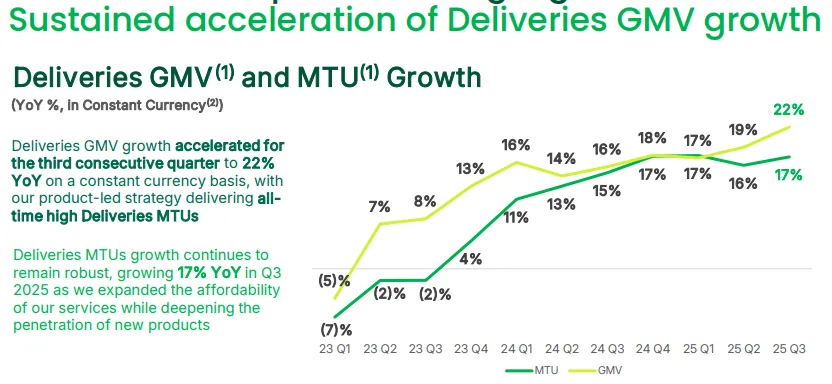
Grab Q3 Investor Presentation
None of that requires regulatory approval. None of it triggers commission scrutiny. GMV expands through usage and participation rather than extraction.
This is why fintech shows up in the model through margins rather than multiples. Higher utilization supports operating leverage in Mobility. Steadier merchant liquidity supports advertising spend, which lifts Deliveries profitability. Reduced incentive intensity preserves EBITDA without raising fees. The effect compounds quietly across the platform.
From a valuation standpoint, this reinforces the use of an enterprise value framework rather than per-share narratives. Fintech does not deserve a separate capitalization. Its contribution is already embedded in consolidated EBITDA as improved efficiency and stability. Attempting to value it as a standalone business double counts upside while ignoring the risk it introduces.
The result is a cleaner distribution of outcomes. Upside comes from disciplined scale and indirect monetization in a tightening regulatory environment. Downside is limited by the balance sheet and the ability to pull back credit exposure if conditions deteriorate. Fintech sits in the middle, enabling growth where regulation cannot reach while remaining constrained by design.
This is the correct place for it in the story. It expands the platform’s operating envelope without expanding its regulatory footprint. That is why it matters, and why it should remain invisible in headline valuation debates.

Conclusion: The Market Is Looking for the Wrong Kind of Upside
The market keeps asking what Grab’s fintech segment can become. That question misses what it already is.
Fintech inside Grab is not an engine designed to re-rate the business on its own. It is infrastructure built to stabilize a platform operating under real constraints. It smooths liquidity for drivers. It gives merchants the confidence to spend on ads. It reduces friction at the point of transaction. It allows GMV to grow through usage rather than through regulated pricing levers.
That role is intentionally limiting. Credit exposure caps how aggressively fintech can be scaled. Self-funding marks the end of its economic ambition, not the beginning. Once it stops consuming capital, its job is done. At that point, it fades into the background and lets the core platform compound quietly.
Investors tend to read that as a missed opportunity. It is better understood as risk management.
In markets where labor, pricing, and platform economics sit under rising scrutiny, indirect growth matters more than visible monetization. Fintech gives Grab room to expand participation and frequency without drawing regulatory response. Advertising captures that activity at high margin without importing labor sensitivity. Mobility and Deliveries benefit from steadier supply and demand without renewed incentive wars.
This is not a story about optionality. It is a story about constraint-aware design.
Grab’s fintech segment does exactly what it is supposed to do. It supports scale. It absorbs volatility. It stays out of the way. That makes the business more durable, even if it makes the narrative less exciting.
For readers who want the full picture, including how this framing flows through our enterprise value–based scenario model, probability weighting, and long-duration return math, our complete Grab Stock Forecast 2030 work is available in the Northwise premium library.

GRAB Stock Forecast 2030: What the Next Ride Earns
Northwise models Grab through 2030: rides, delivery, advertising, lending, cash flow and dilution, with operating scenarios and Premium valuation analysis.

Grab Advertising
Grab advertising is lifting delivery margins through intent-based monetization that avoids labor costs, increased regulation, and pricing scrutiny.

Grab Stock Forecast 2030
A Grab Stock Forecast 2030 scenario modeling revenue, margins, cash, and valuation through across bear, base, bull, and a possible GoTo Merger.
Northwise Portfolios
See how the research becomes real decisions
Reader discussion
Discuss the research
Create a Free account to join the discussion with a display name.
Create a Free Account
No comments yet. Start a thoughtful discussion.