
CIFR Stock Forecast 2027: Cipher Digital's First Year as a Landlord

Our CIFR stock forecast for 2027 follows 493 IT MW of contracted capacity through rent, debt, dilution and three year-end valuations.
In this article
Cipher Digital has signed leases of 15 to 20 years with Amazon, a Google-backed AI cloud and a high investment-grade tenant, and its stock has still lost more than 80% since June. We follow 493 megawatts from construction to rent, then follow the rent through $6.5B of debt and a Google warrant, to see how much reaches common shareholders by the end of 2027.
A Stock Priced for Trouble, a Business Signed for Decades
On June 22, Cipher Digital traded at $30.14. On November 20 it closed at $5.44, down 16% in a single session as AI infrastructure names and bitcoin sold off together. At that price the whole company carries an equity value of about $2.48B, set against roughly $6.7B of debt.
Over the same five months, the contract book moved in the opposite direction. In September, Cipher extended Barber Lake from a 10-year lease to a 20-year commitment worth about $9.1B. Its portfolio now carries $16.6B of base contracted revenue, $28.4B including extensions, and a weighted average lease term of 17.3 years.
The tenants are Fluidstack, with Google guaranteeing part of its obligations, Amazon Web Services, and a high investment-grade company that Cipher has yet to name. Few companies of any size have locked in revenue from counterparties of that quality for that long.
Set those two facts next to each other and they appear to describe different companies. The leases describe a property business with bond-like revenue. The share price describes a market that doubts how much of that revenue will ever belong to the common stock.
We built calendar 2027 month by month to test which description holds up. The answer depends far less on demand than on three narrower questions: whether the last halls get accepted on time, how the capital structure divides the rent, and what investors will pay for contracted rent in December 2027.
From Bitcoin Miner to Landlord
Cipher went public in 2021 through a merger with a blank-check company and spent its early years mining bitcoin in West Texas. Its Odessa site still runs about 207 MW of miners under a fixed-price power agreement near 2.8 cents per kWh. In February 2026 the company renamed itself Cipher Digital, a signal that mining had stopped being the plan.
The pivot shows up clearly in the third quarter. Of $26.7M in revenue, $20.8M still came from mining and only $5.9M from leasing data center capacity, which missed Street expectations near $39M by a wide margin. The quarter's reported $31.6M of net income came almost entirely from a $127.2M noncash gain on a warrant liability.
The scale of what comes next dwarfs those numbers. By December 2027 our Base case has tenants paying for 493 IT MW across three Texas campuses, and the annualized revenue run rate approaches $935M.
What Cipher sells is space, power and cooling. Tenants bring and own the GPUs, run the software and carry the technology risk. On the November call, chief executive Tyler Page made the distinction explicit, describing Cipher as something other than a neocloud.
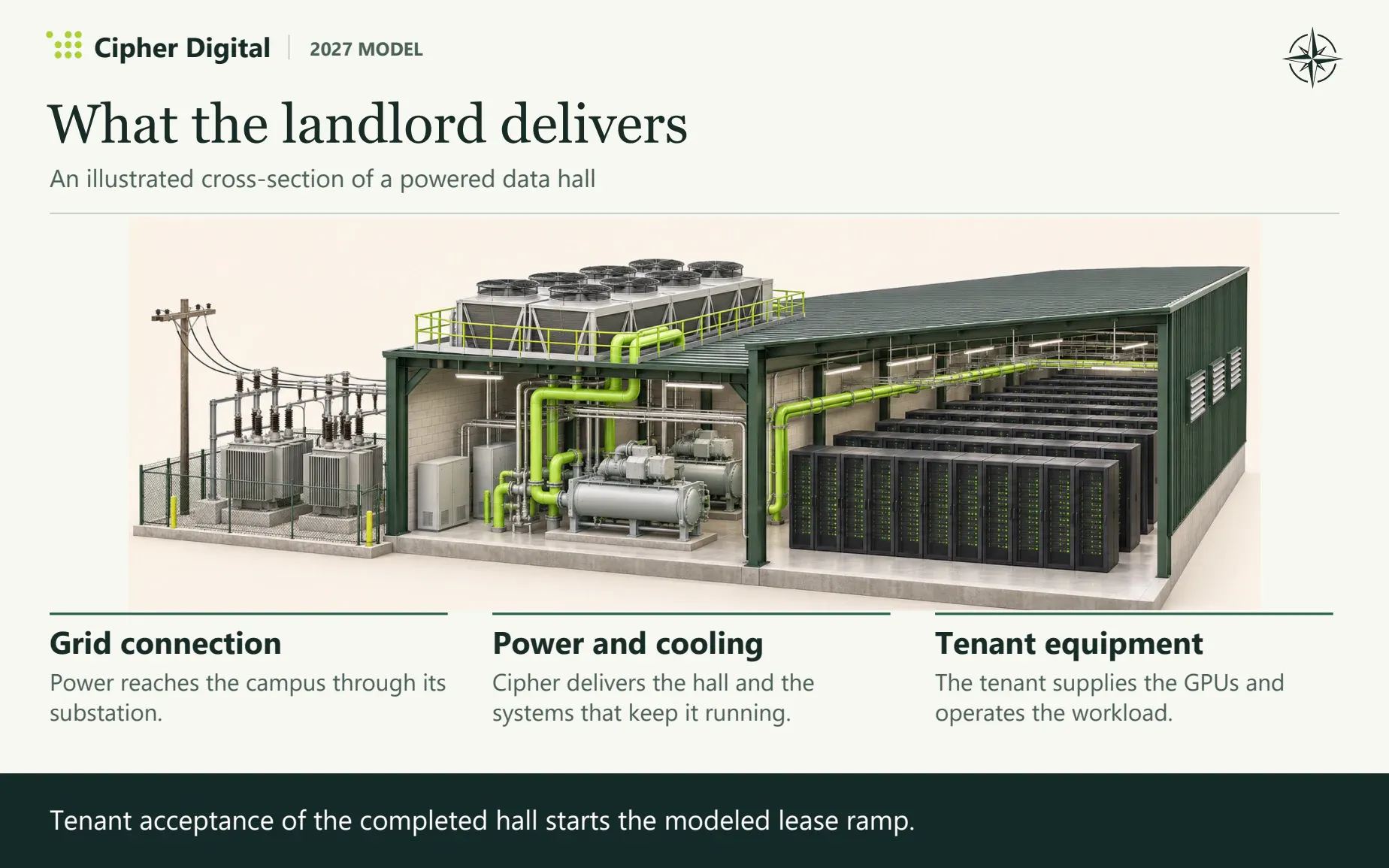
The distinction shapes everything that follows. A neocloud like Nebius or CoreWeave earns more per megawatt and carries GPU depreciation, pricing and utilization risk. A landlord earns less per megawatt, carries construction and financing risk, and gets paid for 15 to 20 years by tenants with balance sheets far stronger than its own.
The Argument Around the Stock
The optimists start with the contracts. Cipher has three signed leases with blue-chip counterparties, financed by project bonds sized against that rent, at a time when energized capacity in Texas is one of the scarcest inputs in the AI buildout. On their view, the market is pricing a crypto miner and missing an infrastructure owner with a 17-year lease book and gigawatts of land and power behind it.
The skeptics start with the timeline and the capital structure. Barber Lake's delivery slipped from September 2026 into a phased schedule that runs into 2027, and Cipher agreed to absorb the first $359.3M of costs above the original budget. Black Pearl's last hall has moved too.
Debt of $6.7B sits ahead of the equity, and a Google warrant with a $435M value floor issues more shares as the stock falls. Texas froze new data center approvals in August, and the governor-elect has pledged to keep them frozen.
Both camps are right about their own facts. They disagree about what the facts are worth to shareholders. The optimists see 493 MW of rent and capitalize it. The skeptics see how much of that rent is already spoken for before it reaches the common stock.
We land with the optimists on the operating business and much closer to the skeptics on what the equity can claim. The three leases are excellent, and the probability that all three campuses are delivered by December 2027 is high. The equity is a thin, levered slice of those leases, and its value at year end depends heavily on what public investors are willing to pay for contracted rent.
Three Campuses, Three Leases
Cipher's 2027 is built on three operating campuses. Each carries its own tenant, lease structure, project bond and delivery schedule.
Campus | Tenant | Gross MW | IT MW | Lease term | Base contracted revenue |
|---|---|---|---|---|---|
Barber Lake | Fluidstack, then a leading AI lab | 300 | 207 | 20 years combined | About $9.1B |
Black Pearl | Amazon Web Services | 300 | 216 | 15 years plus three 5-year options | $5.5B |
Stingray Phase I | High investment-grade tenant, unnamed | 100 | 70 | 15 years plus three 5-year options | $2.0B |
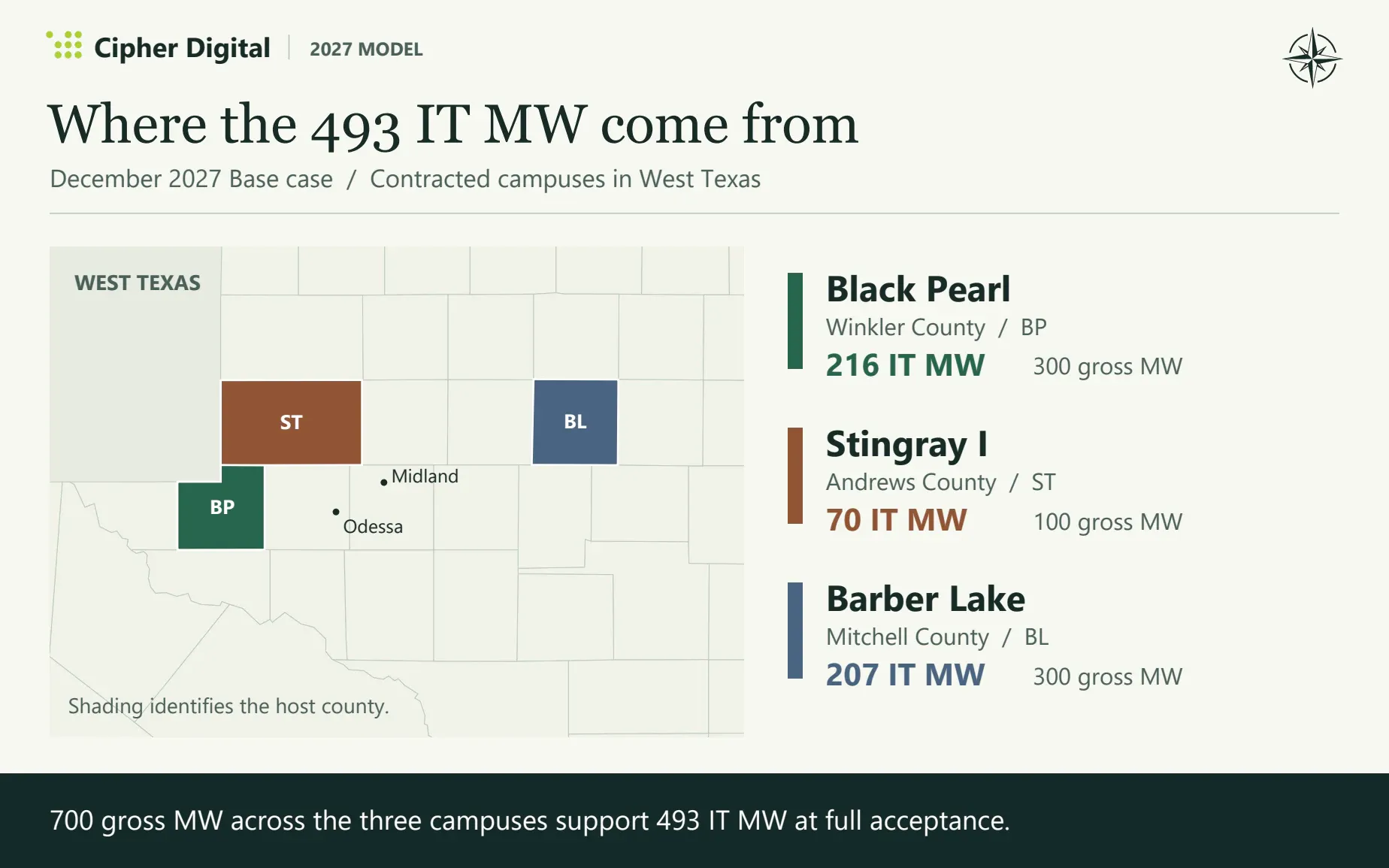
Barber Lake, near Colorado City, is the oldest relationship. Fluidstack signed for 168 MW of critical IT load in September 2025, with Google backstopping $1.4B of its obligations and receiving warrants for about 5.4% of Cipher. Fluidstack later expanded to the full site, and the September 2026 amendment added a binding 10-year follow-on lease from an unnamed AI lab worth about $5.2B.
Black Pearl is Cipher's first direct hyperscaler lease. Amazon signed in late 2025 for 300 gross MW at about $5.5B over 15 years, and the first 18 MW were delivered in August 2026. The remaining Phase I halls were in electrical and mechanical fit-out at the November update.
Stingray is the smallest and the newest. Its first phase covers 10 MW of network capacity and 60 MW of data hall, with shell construction expected to finish in the fourth quarter of 2026. ERCOT's May assessment classified the site as base load, which places its grid capacity outside further study or reallocation.
Black Pearl and Stingray are triple net, so tenants carry operating costs and power. Barber Lake is modified gross, so Cipher pays about $48M a year of site operating costs out of its rent.
How a Megawatt Becomes Rent
Most confusion about Cipher's revenue comes from mixing two kinds of megawatt. Gross MW is the power a site draws from the grid. IT MW is the portion that reaches the tenant's computing equipment after cooling and electrical losses, and it is the unit leases are priced on.
Rent starts hall by hall. Each data hall is built, fitted out and handed to the tenant, and billing begins once the tenant accepts it. A campus can be 90% finished and still collect rent on only a fraction of its capacity.
Revenue in any year therefore depends on the acceptance calendar. Each month a large hall sits unaccepted is a month of rent the year never recovers, though the lease term itself typically runs from acceptance, so the contract keeps its full value.
The project bonds give an unusually clear view of what each campus earns once complete. The financing exhibits show first full-year site NOI of $302M at Barber Lake, $311M at Black Pearl and $112M at Stingray, $725M in total. Cipher's own presentation cites $864M of average annualized NOI over the life of the portfolio, a higher figure that averages escalators and Barber Lake's additional rent across the full term.
We use the first-year figures. They describe what an investor buying the stock at the end of 2027 can reasonably expect from the next twelve months, without crediting growth that arrives in later years.
The 2027 Delivery Calendar
Barber Lake is furthest along. The amendment set hall deliveries between the fourth quarter of 2026 and the first quarter of 2027, and our Base case has about 166 IT MW accepted in January and the full 207 by July. A February central date for the last hall carries later branches in April and July.
Black Pearl turns on one hall. Its final 81 MW hall originally targeted rent in March, and the third-quarter filing references amended configuration and milestones. We treat March as the early branch, June as central and October as late, with a small chance that the hall remains outstanding at year end.
Stingray's bond exhibit originally targeted April rent on the network hall and May on the 60 MW data hall, before November's revised phasing. Our schedule uses May, July and November branches for the data hall, centered on July.
Base case, accepted IT MW | January | March | June | September | December |
|---|---|---|---|---|---|
Barber Lake | 166 | 196 | 206 | 207 | 207 |
Black Pearl | 50 | 144 | 205 | 205 | 216 |
Stingray | 0 | 0 | 27 | 62 | 70 |
Total | 216 | 340 | 437 | 473 | 493 |
The averages hide discrete outcomes. Halls are either accepted or not, so the fractional figures reflect probability-weighted branches across many delivery paths.
The physical risk sits almost entirely in two halls: Black Pearl's 81 MW and Stingray's 60 MW. We start from two execution regimes. In ordinary execution, which carries 85% weight, each hall has a 5% chance of missing year end. Under common commissioning pressure, which carries 15%, those odds rise to 23% and 24%, and the shared regime makes the two misses move together.
December 2027 outcome | Accepted IT MW | Probability |
|---|---|---|
All three campuses accepted | 493 | 85.49% |
Stingray final hall outstanding | 433 | 6.81% |
Black Pearl final hall outstanding | 412 | 6.66% |
Both final halls outstanding | 352 | 1.04% |
These probabilities are our judgments, built from construction progress, the time left before December 2027 and the tenants' acceptance requirements. A handful of completed builds cannot identify the exact odds, and the probabilities should be read as underwriting choices.
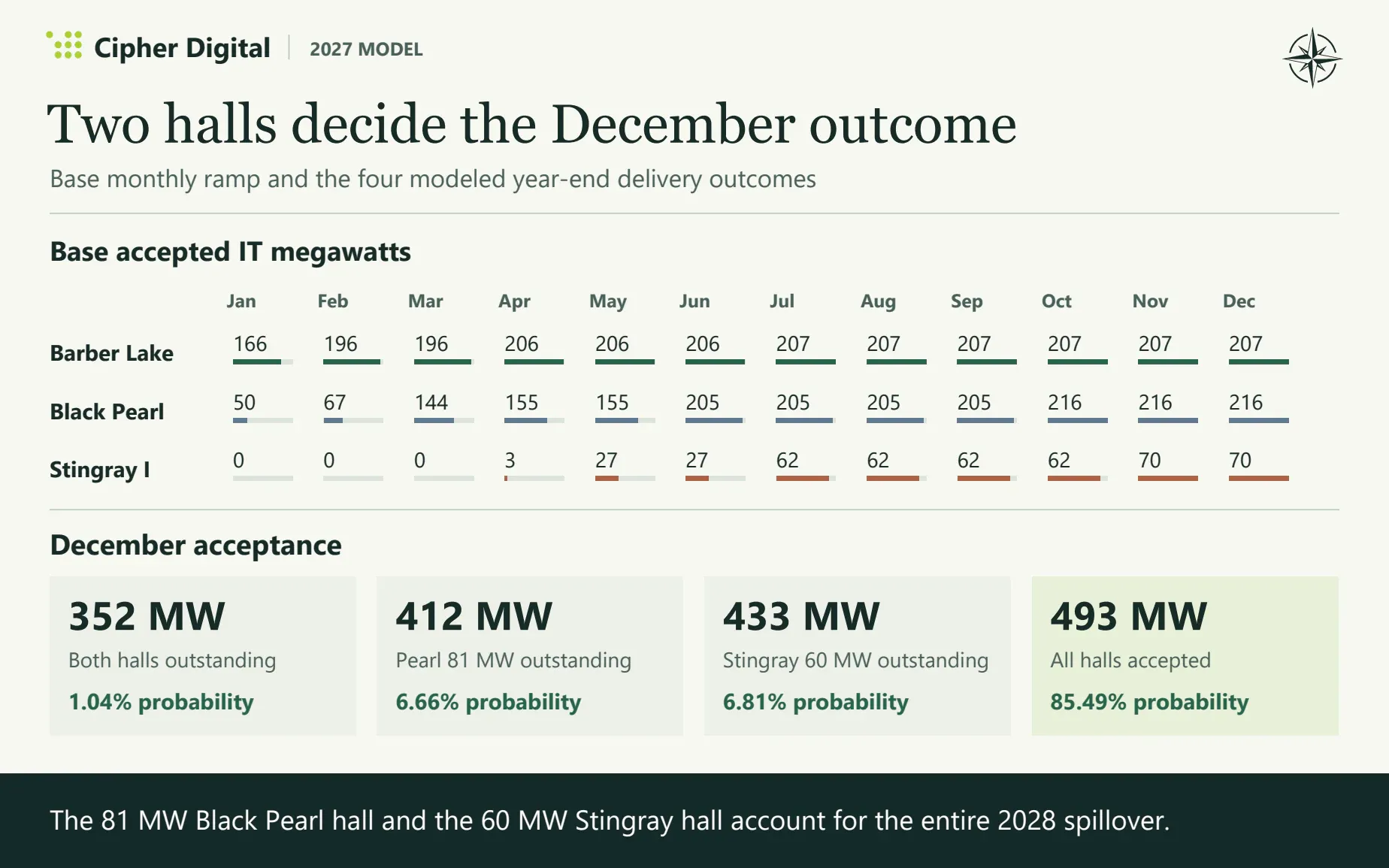
A missed hall slides into 2028. It keeps its signed lease and loses a portion of 2027 rent.
Barber Lake's Overrun and the Rent That Comes With It
The September amendment rewrote the economics of Barber Lake. Change orders and evolving tenant requirements pushed the gross project cost to between $2.941B and $2.966B, according to the October financing exhibit. Cipher agreed to absorb the first $359.3M of costs above the original budget.
Above that threshold, the tenant shares the cost by paying it back as additional rent. The October exhibit projects about $480M of incremental gross rent over the 20-year term on roughly $187M of eligible cost.
We treat the extra rent cautiously. The 2027 forecast recognizes no additional billing from it, since the amended schedule has yet to support a specific payment start. A modeled $50M reimbursement likewise produces no 2027 cash receipt.
The stream still has value. In our valuation work, Barber Lake's incremental rent is a finite asset with its own discount rate and a realization allowance, valued separately from the core lease.
The overrun also carries a funding consequence. If the construction budget understates eligible spending, the shortfall falls to shareholders before any reimbursement arrives.
What 2027 Looks Like on the Income Statement
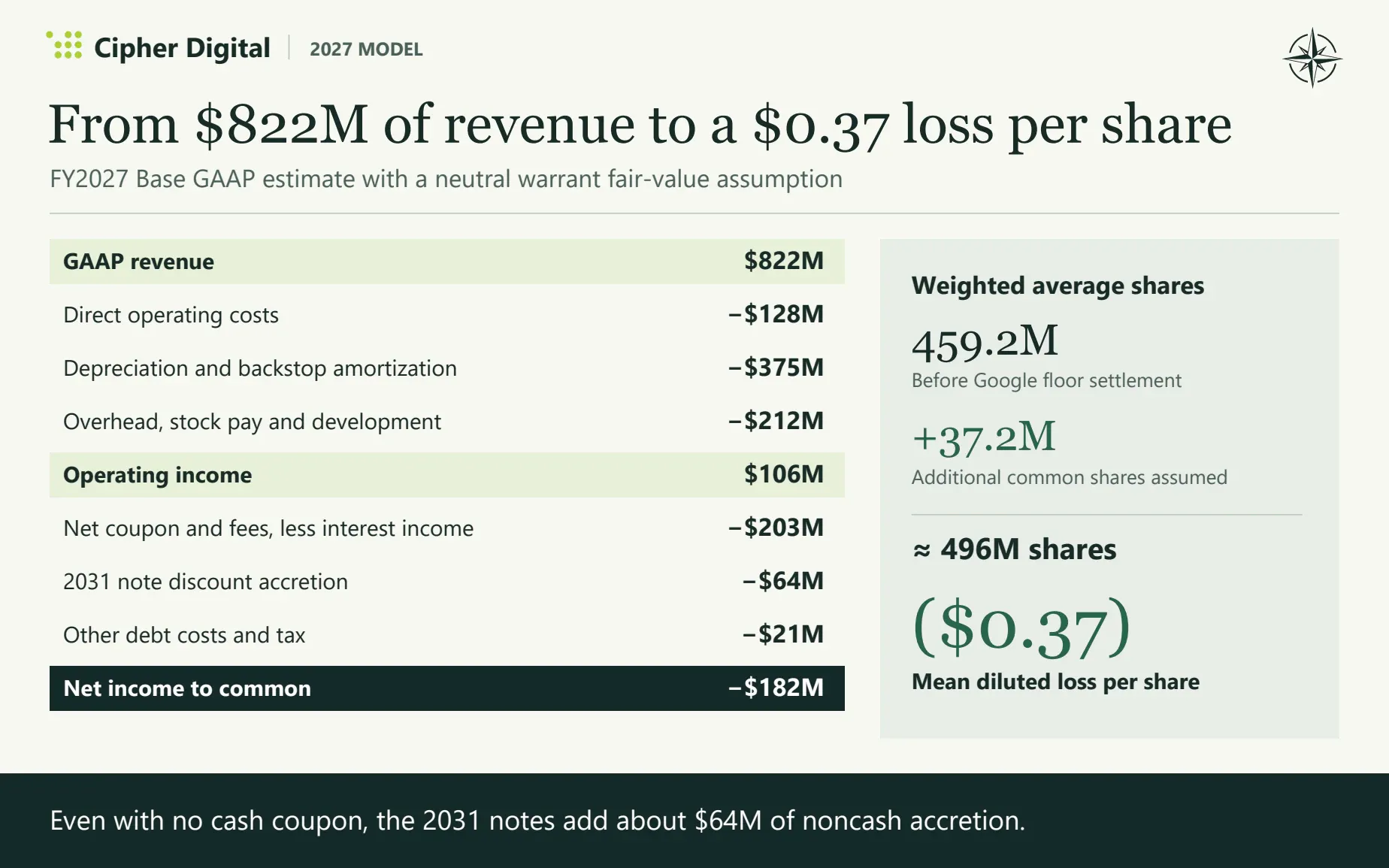
The Base case produces $822M of GAAP revenue in 2027. Fixed lease revenue accounts for $738M, reimbursed power at Black Pearl adds $35M, and residual mining contributes $49M before winding down at midyear in our forecast.
Cash tells a smaller story. Tenants are billed about $624M during the year, and the gap to GAAP lease revenue comes from straight-line accounting, which spreads contractual escalators evenly across the lease and recognizes more revenue than cash in the early years.
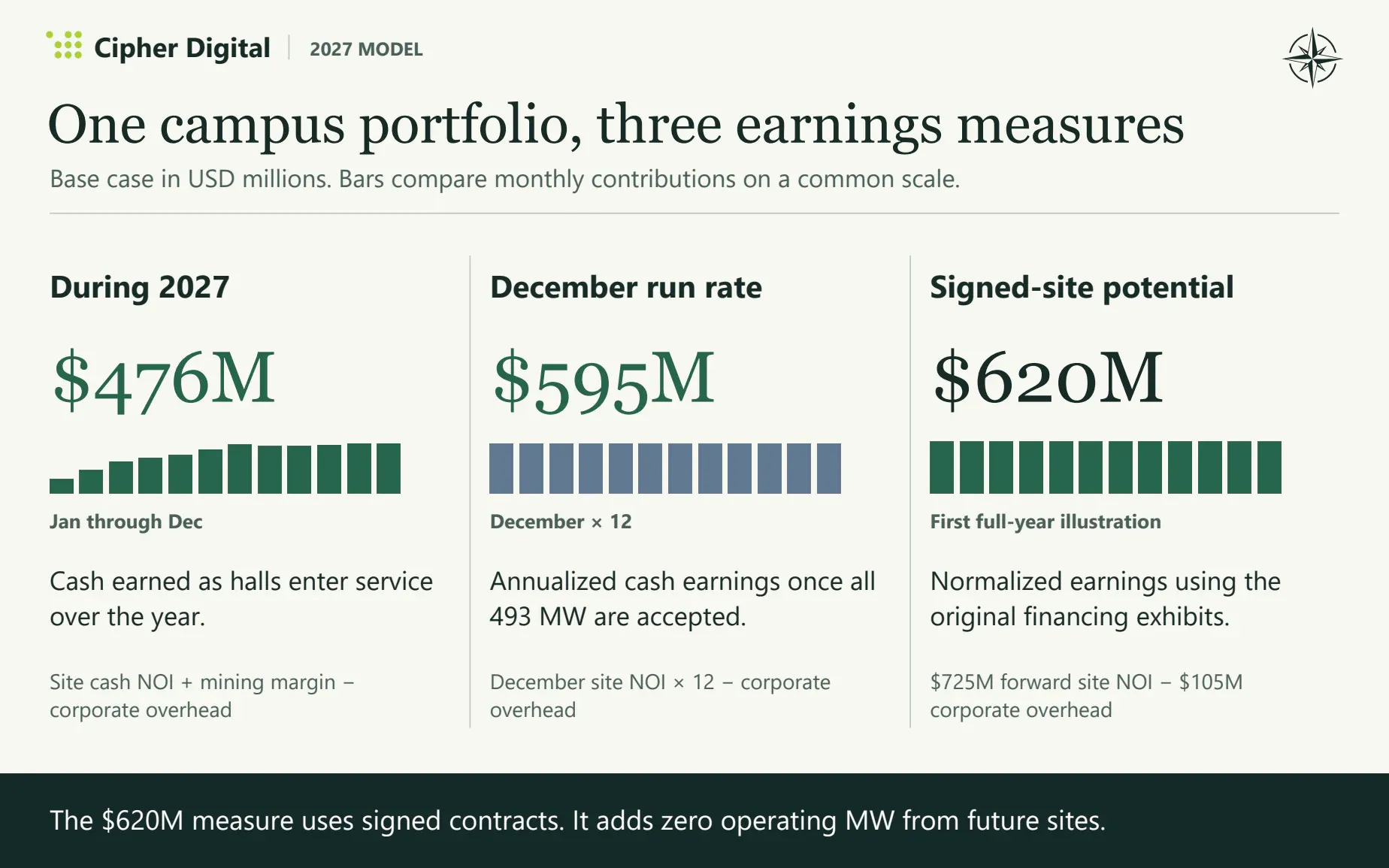
After site operating costs, mining margin and $105M of corporate overhead, cash EBITDA comes to $476M. The run rate climbs through the year as halls arrive, from about $14M in January to about $50M in December, which annualizes to roughly $595M.
Base case, 2027 | Amount |
|---|---|
GAAP revenue | $822M |
Tenant billings | $624M |
Cash EBITDA | $476M |
December cash EBITDA, annualized | $595M |
Depreciation and amortization | $321M |
Net coupon and fees | $250M |
Accretion on 2031 convertible notes | $64M |
Net loss | $182M |
Diluted EPS | ($0.37) |
The company still loses money. Depreciation of $321M arrives as halls are placed in service, and net coupon and fees on the project bonds and parent debt run to $250M. Accounting accretion on the zero-coupon 2031 convertible notes adds $64M, a noncash charge that grows the carrying value toward face.
Smaller items push the loss further. Amortization of the Google backstop adds $54M, stock compensation $65M and expensed development $43M.
The loss narrows steadily. The first quarter loses about $64M and the fourth about $32M, and the gap keeps closing as the full portfolio bills through 2028.
Bear and Bull look almost identical on this line. Bear's average revenue is $770M and its loss per share is $0.40, while Bull earns $823M and loses $0.37. The 2027 income statement barely separates the cases, and the difference between them lives in the balance sheet and the valuation.
Paying for the Last Mile
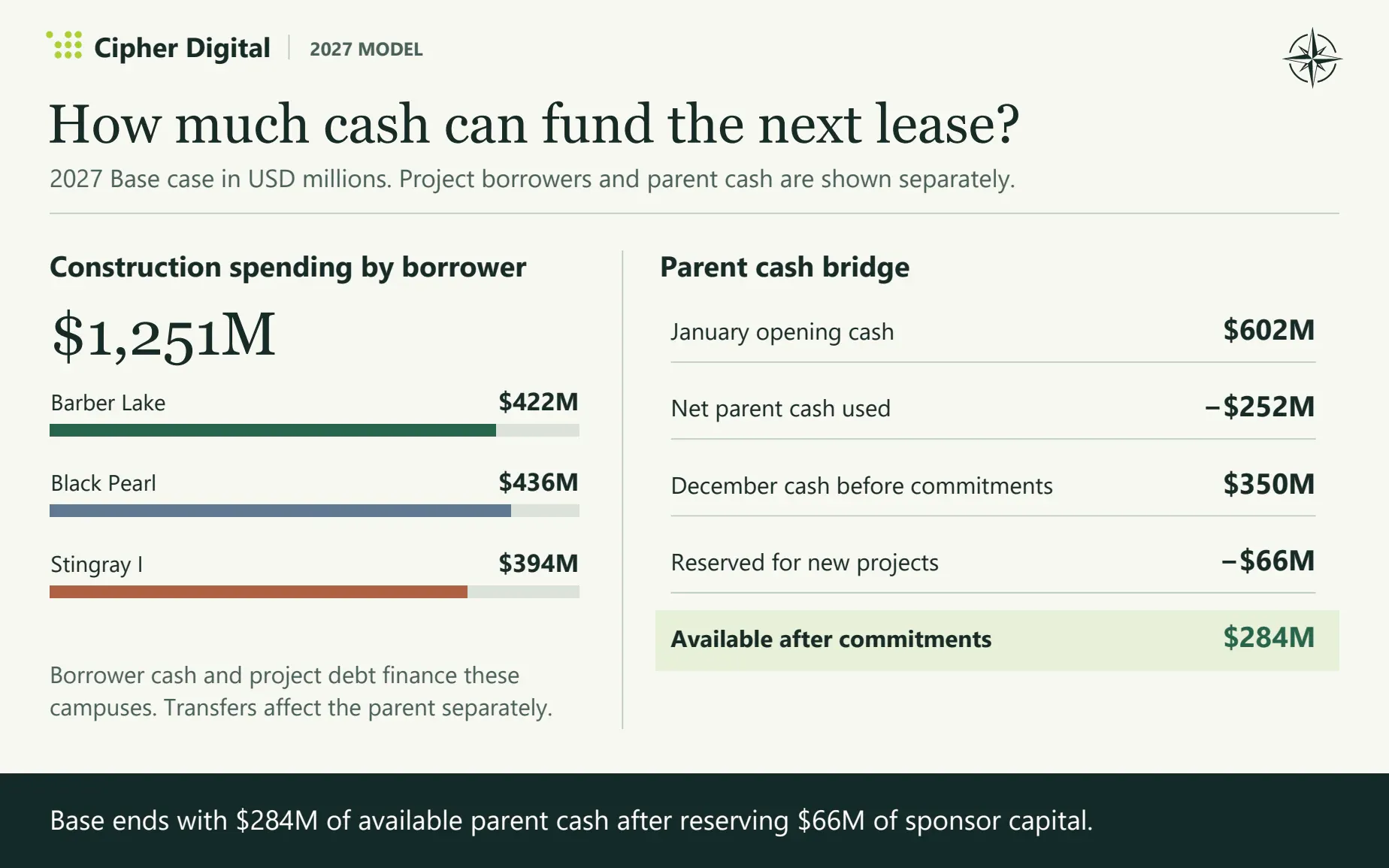
Finishing the three campuses costs about $1.25B in 2027 in our Base case: $422M at Barber Lake, $436M at Black Pearl and $394M at Stingray. Most of it is spent by midyear, and spending falls to nearly zero in the fourth quarter.
Cipher has yet to disclose a cash-to-complete budget by campus. The third-quarter filing shows $1.61B of supplier commitments and $720M of property and equipment purchases sitting in payables, and their overlap and site allocation are undisclosed, so our budgets are built from the amended project economics and the financing exhibits' payment calendars.
Project cash funds most of the bill. Each campus has its own bond issuer, its own restricted cash and its own covenants. Our model starts January with about $774M at Barber Lake, $562M at Black Pearl and $500M at Stingray after estimated fourth-quarter construction and coupons, and draws those balances down as halls are completed.
Parent cash is separate. Cipher reported $724M of parent liquidity pro forma for the October convertible, including bitcoin, and our model opens 2027 near $602M after deducting the bitcoin and estimated fourth-quarter spending. Base closes the year at $350M, with about $66M reserved for equity in new projects and $284M available.
Debt barely moves. Core funded debt, which covers the project notes, parent convertibles and a $200M revolver, ends the year near $6.53B as project amortization begins.
Debt at September 30, 2026, plus October issuance | Principal | Coupon |
|---|---|---|
Barber Lake notes due 2030 | $1,733M | 7.125% |
Black Pearl notes due 2031 | $2,000M | 6.125% |
Stingray notes due 2031 | $810M | 6.000% |
Convertible notes due 2031 | $1,300M | 0% |
Convertible notes due 2032 | $850M | 0% |
Our Base case issues no discretionary common equity in 2027. Contract-backed borrowing, partner capital on new projects and slower development spending all come ahead of selling shares near today's price. The binding constraint on Cipher's equity in 2027 is the Google warrant, which we turn to next.
Google's Warrant and the Share Count
When Google backstopped Fluidstack's lease, it received warrants carrying a floor value of $435M. At settlement, Cipher can deliver that value in shares, cash or both, measured at a contractual volume-weighted average price.
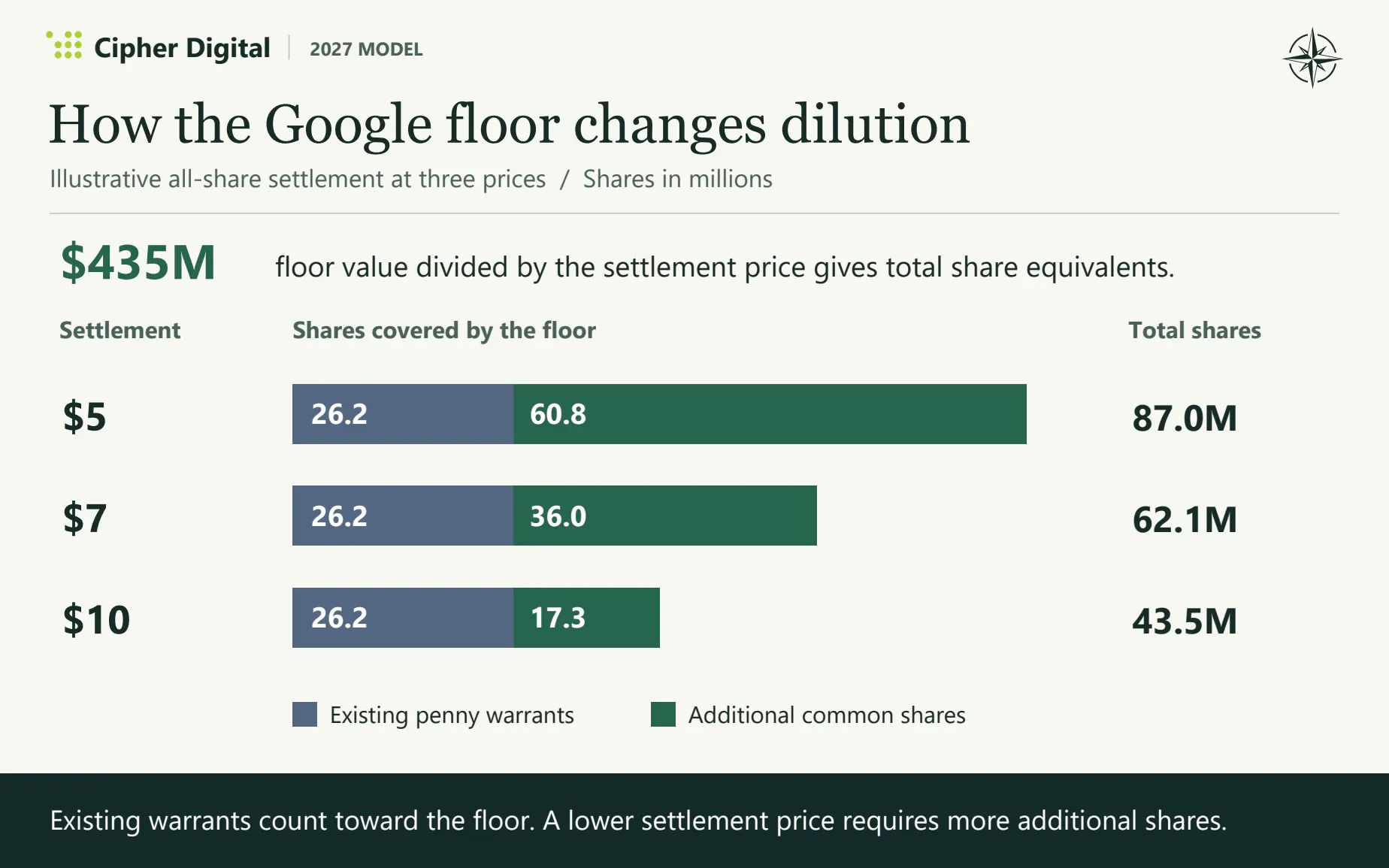
The floor turns the share price into a dilution input. At a $10 settlement price, $435M equals 43.5M shares. At $7 it equals about 62.1M shares, and at $5 it reaches 87M.
The 26.2M penny warrants Google already holds count toward that total, so the additional common issued is the difference. Our Base case assumes all-share settlement and counts the additional common from January 1.
Settlement price | Total share equivalents for $435M | Less existing penny warrants | Additional common |
|---|---|---|---|
$5 | 87.0M | 26.2M | 60.8M |
$7 | 62.1M | 26.2M | 36.0M |
$10 | 43.5M | 26.2M | 17.3M |
Cipher had 456.4M shares outstanding on October 30, and equity awards take the year-end count to about 463.9M. The modeled Google floor settlement brings common shares to roughly 501M before the existing 26.2M penny warrants. In-the-money convertible claims, net of capped calls, add more at higher share prices.
The mechanism creates a feedback loop. A weak stock price at settlement issues more shares, which lowers value per share and makes the stock weaker still. Cipher's contract allows cash settlement, and a strong parent cash position at commencement would give it a way to cut the loop. The classification and settlement timing will be clearer once the warrant commences.
Texas, the Election and the Pipeline
Beyond its three operating campuses, Cipher controls a development pipeline that its November presentation sizes at up to 4.3 GW of grid capacity and 2.5 GW of potential on-site generation. Almost all of it sits in Texas, and Texas has become the hardest place in the country to approve a data center.
In August, Governor Greg Abbott directed regulators to audit every data center seeking a grid connection and paused approvals. In September he told the state's environmental regulator to stop issuing data center permits. On November 3, Democrat Gina Hinojosa defeated Abbott after campaigning on a moratorium on data center approvals until the Legislature passes new protections, and Cipher fell 20% the next day. She takes office January 19.
Some of the freeze has already thawed. The Texas environmental regulator resumed its normal permit review after ERCOT finished collecting community-impact information on November 13. ERCOT plans to deliver its findings to state utility regulators on December 10.
The grid study is a separate gate. At its November 19 meeting, ERCOT reported that only 31% of about 260 tested large-load projects passed a preliminary voltage ride-through test, which measures whether a facility stays connected through grid disturbances. Failing projects get one window to submit improved models, followed by stability studies from February to April 2027 and agreement windows that run through July.
The 31% figure describes a tested population. Applying it to a specific Cipher site would require that site's own result, and none has been published.
The three operating campuses are less exposed. Construction is well advanced, tenants are signed, and Stingray's first phase already carries a base-load classification. The larger exposure lies in the pipeline.
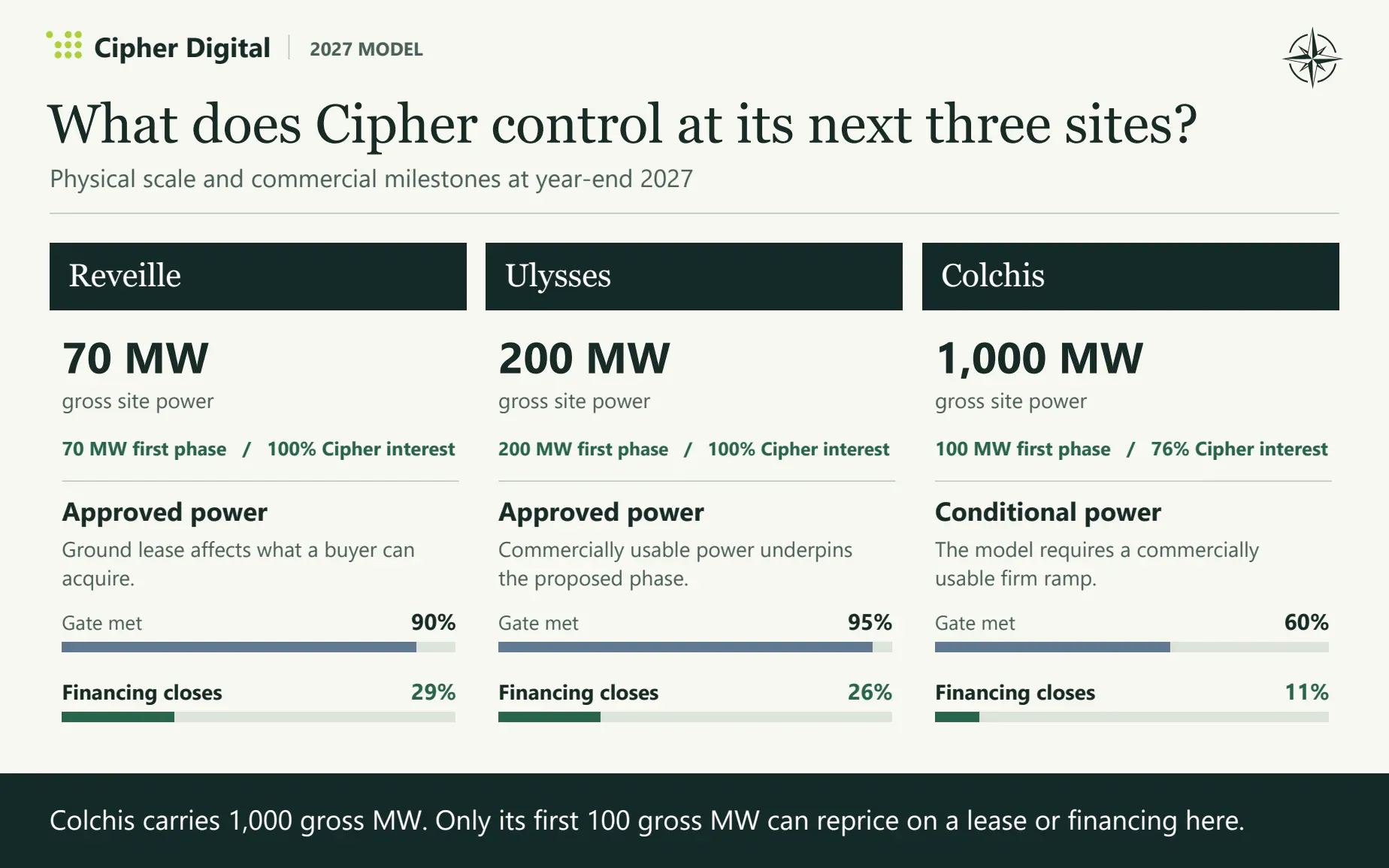
Development site | Gross MW | Power status in November | Our Base odds the power gate is met | Our Base odds a lease is signed |
|---|---|---|---|---|
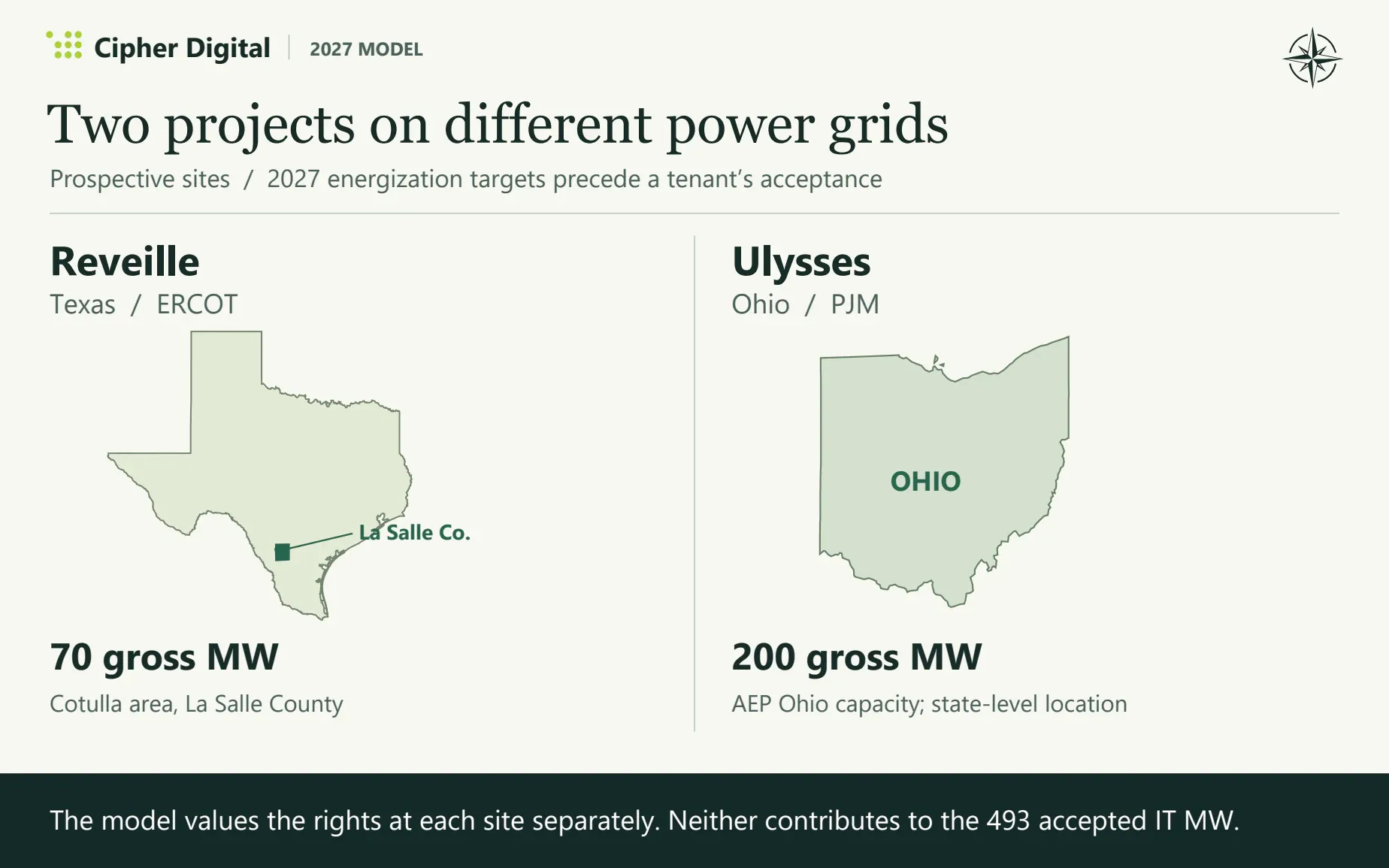
Reveille | 70 | Interconnection approved, substation underway | 90% | 50% |
Ulysses | 200 | Interconnection approved, substation underway | 95% | 62% |
Colchis | 1,000 | Conditional base load, final classification expected December | 60% | 24% |
Five other sites | 2,170 | Conditional studied load or earlier | Stage specific | Rights only |
Reveille and Ulysses are the near-term candidates. Both have approved interconnection, both are in lease discussions, and both target energization in the second half of 2027. Colchis is the large prize at 1 GW, with about 622 acres acquired and conditional base-load status, and we model Cipher's interest at 76%.
Power without a tenant still has a market. Core Scientific disclosed this year that it bought land and an electricity service agreement in Hunt County for $232.5M covering 430 gross MW, roughly $541,000 per gross MW. Transferability, ground-lease terms and ownership determine how much of that reference a given Cipher parcel could support.
A signed lease alone leaves the economics for shareholders open. A new campus needs construction financing, a sponsor equity contribution and often a partner, and each takes a share before Cipher's common equity sees a distribution. We model each prospective lease as its own project with its own loan, coverage requirement and equity hurdle, and Cipher declines or brings in a partner when the terms leave less value than the transferable rights.
The approval risk is correlated. A statewide policy shift could delay every Texas site at once, which limits how much diversification eight sites actually provide.
What the Market Is Paying for Contracted Rent
Valuation multiples for this group have collapsed alongside the share prices. In September, Cipher traded at about 19.8 times estimated 2027 EBITDA. By October the same measure had fallen to about 12.8 times.
The Street still sees much higher value. Rosenblatt's reported $19 target applies 20 times $702.1M of 2028 adjusted EBITDA, Morgan Stanley's reported $27.50 includes about $8.3B of pipeline value, and Bernstein cut its target to $15, citing approval and funding risk. Each of those targets is more than 2.7 times the November 20 close.
The gap between brokers and the tape comes down to two disagreements. The first is the multiple a buyer will pay for long-dated contracted rent from a highly levered owner. The second is how much value the development pipeline can carry before it has power, a tenant and financing in hand.
Published summaries leave out the equity bridges behind those targets: the debt, cash, share counts and pipeline values that turn an enterprise value into a share price. In the premium section we set those published targets beside our own valuation.
What Would Change Our View
Acceptance notices come first. Black Pearl's final 81 MW hall by midyear and Stingray's 60 MW data hall by late summer would confirm the Base delivery path. A slip into the fourth quarter at either site would move us toward Bear, and a slip past December would cost 2027 rent and add construction risk to the year-end valuation.
On costs, a revised cost-to-complete for Barber Lake, the first billing of its additional rent, or any obligation beyond the modeled budget would change both cash and value. The 10-K will also confirm fourth-quarter balances, convertible accounting and the warrant mark.
On the pipeline, the evidence that would justify more value is concrete: a site-specific ERCOT result, a priced bid for transferable power, or a signed lease that arrives with project debt terms and a clear statement of Cipher's retained ownership. Any one of those would tell shareholders how much of a new campus actually reaches them.
On Texas, the governor-elect's first actions after January 19 matter most for the pipeline and very little for the three operating campuses. ERCOT's December findings and its voltage test results will show how much of the conditional pipeline is still on the path to power.
On the stock itself, the Google warrant's settlement price and method will set a large share of 2027 dilution. A cash settlement or a higher share price at settlement would leave more value per share for everyone else.
Where This Leaves Us
Cipher Digital has made the hard transition. It owns three campuses leased to some of the strongest credits in technology for 15 to 20 years, financed with project bonds sized against that rent, and in our Base case all 493 IT MW are paying by November 2027. The probability that all three campuses are fully accepted by year end is about 85%.
The equity sits behind a lot of claims. Roughly $6.5B of debt, a Google warrant that dilutes more as the price falls, a Barber Lake overrun that shareholders fund first, and a corporate cost base all come ahead of common shareholders. On the income statement, the company still loses money in 2027.
The market's discount captures those claims and then adds two more: fear that Texas politics will strand the pipeline, and a sharp fall in what investors will pay for contracted AI rent of any kind. We think the first fear is mostly about the pipeline and mostly irrelevant to the three leases. The second is a real variable, and it decides more of Cipher's December 2027 value than any construction date.
How much of 493 MW of contracted rent reaches the common stock is a valuation question, and that is where the premium section picks up.
Inside Premium
The premium section values Cipher Digital on December 31, 2027 using two complete methods, one built on public-market multiples and one built on the value of each asset, and shows how they combine. It walks the bridge from rent to value per share, values each delivery outcome and the development pipeline, and compares our numbers with the Street's published targets. It closes with the probability-weighted target, the sensitivities that move it most, the Northwise rating and entry zones, and what the current price implies for new buyers and existing shareholders.
Northwise Premium
Choose how to continue with Northwise
Join Northwise Premium
Unlock the rest of this report, its complete valuation, the downloadable model, portfolios, and action framework.
Join Northwise PremiumCreate a Free Account
Continue across Free Northwise research, follow companies, save reports, and receive updates.
Create a Free Account
Beyond Neocloud: A New Map of AI Infrastructure
Northwise proposes nine AI infrastructure categories, comparing Nebius, CoreWeave, IREN, GPU renters and hosts by software, financing and commoditization risk.
CIFR Stock Forecast
Cipher Digital has proven that hyperscalers will lease its capacity. The open question is whether it can finance four gigawatts without giving away too much of the economics.

CIFR Barber Lake Site
Barber Lake: Fluidstack's contracted capacity, phased delivery, Google's support and the September update on Colorado City's water infrastructure.
Northwise Portfolios
See how the research becomes real decisions
Reader discussion
Discuss the research
Premium access is required to join this report's discussion.
Join Northwise Premium
No comments yet. Start a thoughtful discussion.