
AST SpaceMobile Stock Analysis
AST SpaceMobile stock analysis exploring direct to device satellites, carrier partnerships, technology, risks, and long term potential.
In this article
AST SpaceMobile Stock Analysis: The Dead Zone Economy
A deep dive into ASTS, satellite to phone connectivity, and the economics behind a carrier neutral space based network.
Is ASTS Stock a Buy?
Most investors approach AST SpaceMobile through a lens of disbelief. The concept feels too ambitious. The engineering sounds improbable. The financial timeline stretches farther than a traditional growth investor enjoys contemplating.
The stock trades with the personality of a speculative asset and the volatility of a company still proving its right to exist. Yet beneath that instability sits one of the clearest asymmetries in the public markets.
If ASTS succeeds it will not be another satellite company. It will become a global roaming layer that extends the reach of every mobile network operator in the world.
The question facing long term investors is not whether the stock behaves erratically in the pre revenue phase. It is whether the underlying system makes sense and whether the company is positioned to capture value once the constellation becomes operational.
This article is designed to answer that question with a fuller narrative arc. It blends physics economics regulation and industry positioning to explain what AST SpaceMobile actually is. In doing so it grounds the keyword question many investors search for today which is simply: what is ASTS stock.
What Is AST SpaceMobile Stock And Why It Exists
The modern cellular network is built on a foundational flaw. Carriers advertise near universal population coverage but population is not geography. The signal disappears whenever a user moves through farmland highways coastal waters mountains or national parks.
These dead zones are dismissed as minor gaps in the network. In reality they represent significant economic loss. Dropped calls lower productivity. Offline maps disrupt travel. Remote workers lose coverage. Logistics networks fall offline. Tens of millions of devices spend part of their daily life without service.

AST SpaceMobile exists to erase that gap. The company is building the first satellite based cellular broadband network that connects directly to standard unmodified mobile phones. No terminals. No new hardware. No special antennas.
The satellite becomes a roaming extension of the terrestrial network and the user simply sees their carrier logo appear in places where the signal was previously unavailable. It is a simple idea layered on top of extraordinarily complex engineering.
The reason this matters is straightforward. If carriers can offer one hundred percent geographic coverage they increase retention lower churn reduce network gaps and strengthen their competitive position. AST SpaceMobile is not selling coverage. It is selling certainty.
How Direct To Device Satellite Connectivity Works In Practice
The most common misconception about AST SpaceMobile is that the company is promising something that conflicts with the laws of physics. The smartphone was designed to communicate with a tower a few kilometers away. A satellite is hundreds of kilometers above Earth. The path loss alone is enormous.
AST SpaceMobile solves this in the most direct way possible. The solution is surface area. The Block 2 BlueBird satellites unfold into massive phased array antennas more than two thousand square feet in size. These arrays collect faint signals from a phone and transmit highly focused beams back to Earth.
The larger the antenna the more signal power it can gather and the more efficiently it can transmit. This is not theoretical. It is the same principle that governs radio telescopes and radar systems.
The system would not be viable without the AST5000 ASIC. Earlier prototypes used flexible but power hungry FPGAs. The new chip is custom designed to process dynamic beamforming across thousands of antenna elements with far lower energy consumption. This allows the satellite to manage the demands of broadband connectivity within the strict constraints of power generation and heat dissipation in low Earth orbit.
Thermal cycling presents another challenge. As the satellite transitions between shadow and sunlight the structure expands and contracts. A phased array requires precise knowledge of the position of each antenna element.
Instead of attempting to build a perfectly rigid structure AST SpaceMobile continuously measures the shape of the array and adjusts the beamforming coefficients electronically. The satellite reshapes its signal in software even as the physical structure changes. This is one of the more elegant engineering solutions in the entire constellation design.
The Carrier Neutral Wholesale Model Explained
Most satellite companies face a brutal problem. To make money they have to acquire customers. That means marketing spend billing infrastructure customer support and physical hardware distribution. Customer acquisition cost dominates the business model.
AST SpaceMobile chose a different path. It does not sell directly to consumers. It partners with carriers who already have subscriber relationships. AT&T Verizon Vodafone Rakuten and others provide licensed spectrum and regulatory sponsorship. AST SpaceMobile provides a roaming layer for the geography terrestrial towers cannot reach.
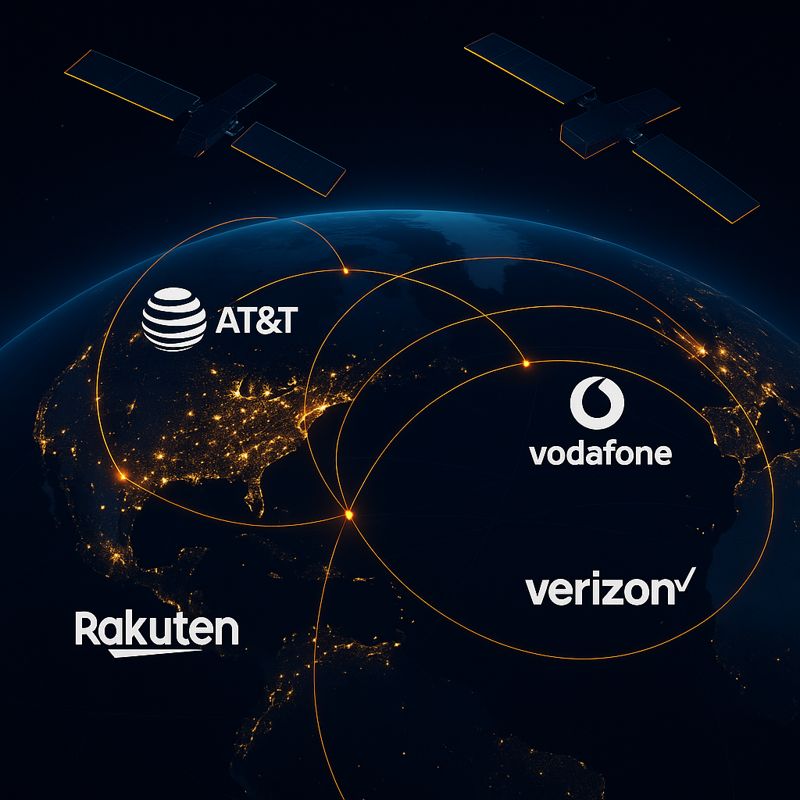
A user does not switch networks. They remain an AT&T or Verizon customer and pay an add on when moving through a dead zone. Billing is handled entirely by the carrier. AST SpaceMobile simply receives a revenue share. The company avoids the entire cost structure of consumer telecom. No retail footprint. No device subsidies. No churn management. No billing disputes.
This creates what may eventually become a defining financial characteristic of the business. As the constellation scales the incremental cost of serving each new user approaches zero. High fixed cost low marginal cost businesses often produce unusually strong operating leverage and high EBITDA margins once they mature.
The Dead Zone Economy And Global TAM
The world tends to think about satellite connectivity in the context of rural villages or developing markets. AST SpaceMobile does address those regions but the near term economics are concentrated elsewhere.
The most immediate and profitable revenue sits in the developed world. Large regions of the United States Europe Japan and Australia have no usable cellular coverage even though population density is high. Highways coastal areas inland waterways mountain passes farmland and sparsely populated regions all create daily dead zones for millions of users.
These gaps cause competitive friction for carriers who lose customers due to unreliable coverage. If AST SpaceMobile enables carriers to advertise complete geographic coverage even a small percentage of users purchasing a premium add on meaningfully lifts revenue.
The longer term market sits in the developing world. Billions of people lack consistent cellular coverage because terrestrial tower economics fail in low density regions. A satellite based network becomes the primary coverage layer. ARPU is lower but the addressable user base is significantly larger. Over a long horizon this segment could generate recurring high volume revenue that carries the profile of utility throughput.
Government and public safety markets form the third segment. First responder networks require uninterrupted signal. If AST SpaceMobile receives FirstNet certification it positions the service as a mission critical coverage layer for emergency communications. This is a long cycle market with unusually sticky contracts.
AST SpaceMobile’s Technology Stack And Why It Matters
The BlueBird satellite family forms the operational backbone of the constellation. Block 1 demonstrated that the system works. Block 2 scales the concept and transitions the company from experimental testing to commercial readiness.
The modular Micron antenna architecture supports standardized manufacturing and reduces the risk inherent in custom spacecraft. Modularity is a strategic choice not a convenience. It is what allows the company to eventually produce multiple large satellites each month.
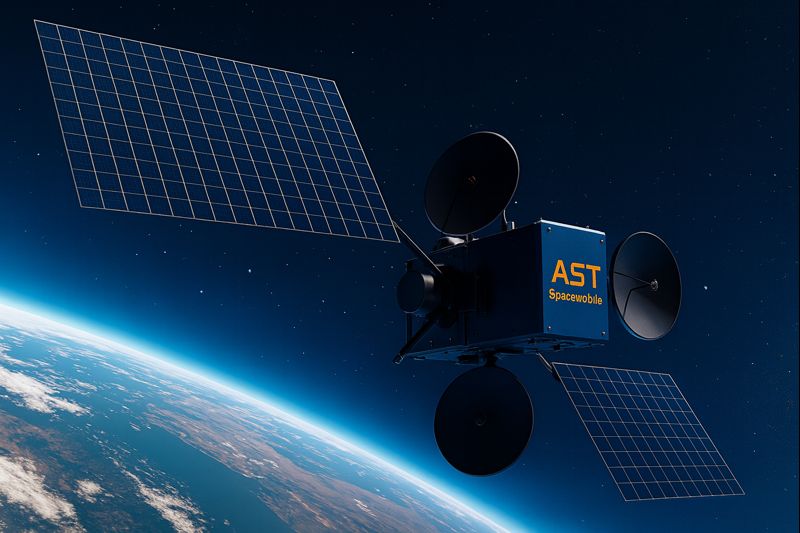
The AST5000 ASIC is equally important. Without custom silicon the power and thermal constraints of broadband beamforming would limit throughput and reliability. With it each satellite becomes significantly more capable and more energy efficient. Performance per watt is the constraint in space. The ASIC is designed to maximize that ratio.
The company also secured global S Band spectrum rights. This gives AST SpaceMobile optionality in markets where carrier partnerships are still developing. It also provides a long term hedge against regulatory delay.
Satellite design extends to launch decisions. The ability to fly on multiple launch vehicles reduces dependency on any single provider and mitigates one of the operational risks that often slows constellation deployment.
Competitive Landscape And Why Physics Matters More Than Branding
Several companies describe themselves as competitors to AST SpaceMobile but very few offer comparable capability. Starlink has deployed direct to cell payloads and partnered with T Mobile. Their system shows potential for basic messaging and limited voice in ideal outdoor conditions. Their phased array is far smaller than the BlueBird architecture which limits indoor penetration and broadband viability.
Lynk Global pioneered early demonstrations but relies on microsatellites. They are well suited for intermittent SMS but lack the power and surface area to deliver sustained broadband.
Globalstar supports Apple’s emergency SOS functionality but this is not a data service. It is a safety feature built for niche scenarios.
Project Kuiper focuses primarily on terminal based broadband similar to early Starlink offerings. It does not currently pursue direct to device connectivity at scale.
The competitive environment reduces to a simple truth. Satellite to phone broadband is governed by physics. Antenna aperture and power constraints define capability. AST SpaceMobile is building at a scale equal to the task. Most competitors are not.
Financial Setup And Unit Economics For ASTS
Pre revenue companies often appear unattractive on a trailing basis. AST SpaceMobile is no exception. Revenue today comes from government contracts and gateway deliveries.
Losses widen as the company ramps its manufacturing infrastructure. Capex spiked in 2025 as AST SpaceMobile procured equipment for Block 2 production. These quarters do not reflect the financial profile of the eventual business. They reflect the buildout of orbital infrastructure.
The company ended Q3 2025 with approximately 3.2B dollars in liquidity after raising capital while the stock traded at higher levels. This funding is intended to carry the company through the initial constellation deployment. The manufacturing target is roughly six satellites per month by the end of 2026.
Long term unit economics are what make the story compelling. A Block 2 satellite may cost fifteen to twenty million dollars. Its revenue potential over a seven to ten year lifespan can reach into the hundreds of millions depending on coverage intensity and attach rates. Few industries produce assets with this profile. High upfront cost combined with extremely low marginal cost often leads to durable economic advantage when scaled correctly.
Regulatory Landscape And The Supplemental Coverage From Space Rules
The regulatory environment shapes the pace of commercial rollout. The FCC’s supplemental coverage from space framework provides the legal foundation for AST SpaceMobile to operate using the licensed spectrum of mobile network operators. This avoids the multi year process of acquiring independent international spectrum rights.

The interference disputes with SpaceX and T Mobile reflect the tension between different approaches to satellite connectivity. AST SpaceMobile argues that it remains within established spectral masks and does not require the waivers sought by competitors. This distinction matters significantly for international expansion since countries often rely on the FCC’s compliance framework when assessing foreign operators.
Global market access depends on carrier partners sponsoring landing rights. India is one of the largest opportunities in the world and also one of the most complex regulatory ecosystems. Vodafone Idea plays a critical role here. Japan appears farther along with Rakuten Mobile preparing for commercial launch contingent on Block 2 deployment. The company may also qualify for portions of the 5G Fund for Rural America which supports rural connectivity through low latency networks.
Key Risks Long Term Investors Must Understand
AST SpaceMobile carries a real risk profile not a theoretical one. The manufacturing ramp is the most important near term execution challenge. The company must transition from a low rate, hardware heavy process into an assembly line that produces large satellites at scale. Any bottleneck in components such as solar cells or custom ASICs can slow progress.
Technological risk exists as well. The Block 2 satellite must unfold correctly and operate reliably in thermal conditions that test structural integrity. Scaling a structure to this size introduces unknowns that only real world deployment can reveal.
Launch cadence is an ongoing constraint. Even with access to multiple launch providers the global manifest often experiences delays. These delays push revenue timelines and increase capital consumption.
Regulatory outcomes remain important. Favorable supplemental coverage outcomes support the plan. Unfavorable interference decisions or international setbacks could slow commercial availability.
How Long Term Investors Should Think About AST SpaceMobile
AST SpaceMobile is not a traditional growth company. It behaves like an early stage utility attempting to build the next layer of global telecommunications infrastructure. The stock reflects the uncertainty of that ambition. It sells off on delays rallies on technical milestones and confounds investors who expect linear progress.
Yet the fundamental idea is unusually clear. If the satellite architecture works at scale and if the company deploys the constellation successfully AST SpaceMobile becomes a coverage layer that sits underneath the mobile networks of the world.
It earns a share of roaming revenue from both developed world dead zones and the billions of users who lack stable connectivity today. The model inherits the characteristics of infrastructure. High fixed cost low marginal cost, long asset life and durable recurring revenue.
The gap between failure and dominance is wide but not vague. Technical execution unlocks a business that could evolve into a global utility. Technical failure ends the story abruptly. For investors who understand the scale of both outcomes AST SpaceMobile represents a rare form of optionality.
It is a company attempting to redraw the physical boundaries of the mobile network. The market prices it like a speculative asset because that is how investors react to uncertainty. The opportunity exists because the underlying idea is much larger than the current market narrative allows.
If this system works it will not simply add coverage to the map. It will erase the concept of a dead zone entirely.

ASTS Stock Price
ASTS Stock Price is a controversial topic. Is it justified or not? This piece explores the unparalleled TAM, strategic vision, and leadership of ASTS.

Celsius Stock Analysis: The Shelf Reset and the Second Growth Curve
Celsius stock analysis of the shelf reset, Alani growth, Pepsi economics and cash flow, with a 2030 model and a Premium valuation and entry-price framework.

Meta AI Spending: The Customer Is Already Here
Can Meta turn AI spending into shareholder returns? We model advertising, Muse, hardware, capital costs and cash flow through 2030, with a full valuation.
Northwise Portfolios
See how the research becomes real decisions
Reader discussion
Discuss the research
Create a Free account to join the discussion with a display name.
Create a Free Account
No comments yet. Start a thoughtful discussion.