
AMD Total Addressable Market

AMD’s total addressable market is shaped by a $500B AI accelerator market and a $1.7T compute stack driven by scale, power, and supply.
In this article
AMD Total Addressable Market: Why AMD Wins Without Winning the AI Model Wars
AMD’s long term opportunity expands with the scale of global AI infrastructure, shaped by supply constraints, procurement dynamics, and the physical limits of compute deployment.
AMD’s Position in the AI Accelerator Market
The market continues to frame AMD’s total addressable market as a function of competitive displacement, anchoring its upside to share gains taken directly from NVIDIA. That framing understates the size and nature of the opportunity.
By 2030, we project annual spending on AI accelerators alone to exceed $500B, while total investment across the AI compute stack, including memory, networking, interconnects, and rack scale systems, approaches $1.7T.
In an environment defined by power availability, advanced packaging throughput, and deployment velocity, addressable market expands based on who can reliably deliver capacity at scale. AMD’s position inside this system grows alongside the market itself, driven by structural demand rather than model leadership.
The Market Is Defining AMD’s TAM Too Narrowly
Most estimates of AMD’s total addressable market still anchor the company to a narrow slice of the AI accelerator conversation. The focus tends to sit on unit share, benchmark comparisons, and whether AMD can meaningfully displace NVIDIA at the top of the training stack. That lens assumes the market clears on performance leadership alone. It does not reflect how AI infrastructure is actually being deployed at scale.
The AI accelerator market does not exist in isolation. Accelerators sit inside a broader system that includes CPUs, high bandwidth memory, networking, interconnects, power delivery, cooling, and validated rack scale architectures.
By 2030, this full compute stack approaches $1.7T in annual spend, with accelerators representing only a portion of the value captured. As deployments move from experimental clusters to production infrastructure, procurement decisions increasingly reflect system availability, integration risk, and long term capacity planning rather than marginal performance differences.
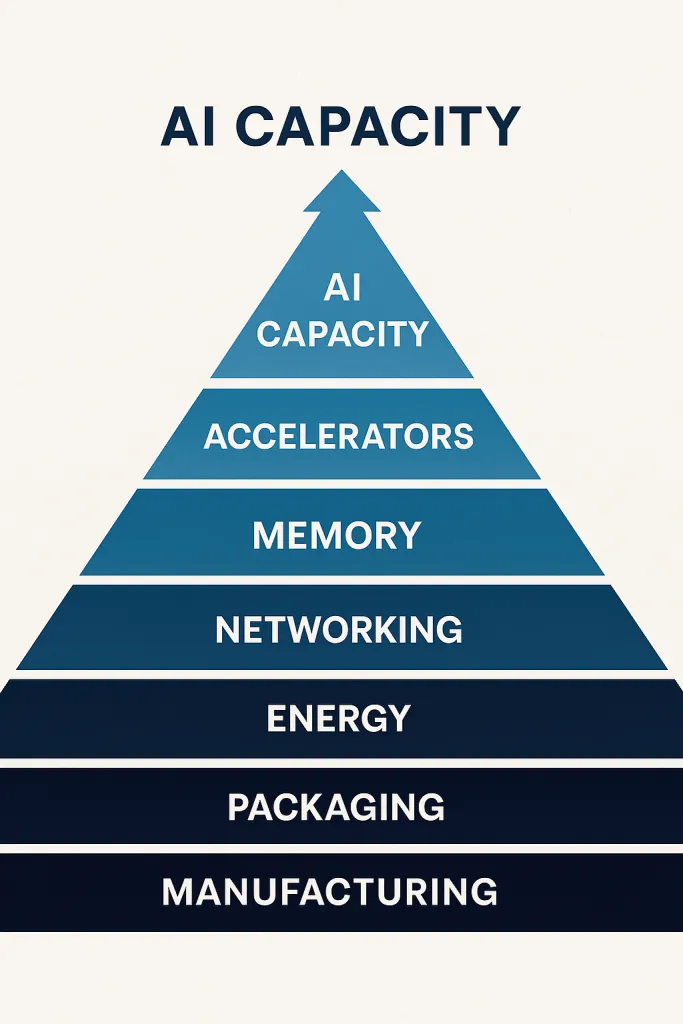
This shift matters for how AMD’s opportunity should be sized. AMD participates across multiple layers of the AI compute stack, including CPUs, accelerators, networking, and increasingly system level platforms. When the addressable market is framed at the system level rather than the component level, AMD’s exposure expands materially without requiring dominance in any single product category.
The market continues to price AMD as a share taker in accelerators. The reality is closer to AMD being a recurring participant in a growing infrastructure budget that cannot be served by a single vendor.
Software and Tooling Are Lowering the Cost of AMD Adoption
One of the historical constraints on AMD’s addressable market sat outside hardware. Deployment friction, tooling gaps, and workflow incompatibility slowed adoption even when performance and pricing were competitive. That barrier has narrowed materially over the past 18 months, expanding the set of workloads and buyers that can realistically deploy AMD accelerators at scale.
The maturation of Triton as a first class inference framework has played a central role. Native Triton support allows developers to write and optimize kernels once, then target multiple backends without rewriting models or retraining teams. As Triton adoption has grown across hyperscalers and model developers, the cost of supporting AMD hardware inside existing inference pipelines has fallen. This matters most in production environments, where operational simplicity often outweighs marginal performance gains.
At the platform level, ROCm has reached a stage where deployment reliability and tooling depth support sustained production use. Compiler stability, improved support for low precision formats, and tighter integration with PyTorch workflows have reduced the operational burden associated with running mixed vendor clusters. These improvements do not eliminate ecosystem differences, but they materially reduce the switching and coexistence costs that previously constrained AMD’s participation.
Large platform providers have reinforced this trend. Microsoft has invested in internal conversion tooling that allows CUDA based workloads to be translated and validated for alternative accelerator stacks. These efforts reflect a broader procurement reality. Hyperscalers benefit from portability and leverage. Tooling that lowers migration cost expands the practical addressable market for suppliers aligned with open standards.
Taken together, these developments shift AMD’s opportunity from being gated by software readiness to being shaped by capacity, power, and system availability. As implementation friction declines, AMD’s total addressable market expands beyond early adopters and into mainstream production deployments, where scale and reliability determine purchasing behavior.
Second Supplier Status Expands, Not Shrinks, AMD’s Addressable Market
As implementation friction declines, procurement behavior shifts in predictable ways. Buyers stop treating alternative suppliers as contingency options and begin integrating them into baseline capacity planning. This transition materially expands AMD’s total addressable market, even when it is not the primary vendor on a given deployment.
At scale, hyperscalers and large enterprises do not optimize infrastructure around a single supplier. They optimize around availability, leverage, and long term flexibility. Power limits, packaging throughput, and deployment timelines introduce uncertainty that cannot be managed through exclusive relationships. Maintaining a second supplier becomes a structural requirement rather than a tactical hedge.
This requirement changes how addressable market should be measured. AMD does not need to replace incumbent deployments to participate in them. It participates as incremental capacity that enables projects to proceed on schedule, regions to scale independently, and budgets to remain defensible over multi year horizons. In these environments, AMD’s share reflects the portion of demand that cannot be served efficiently by a single vendor, not the portion that switches allegiance.
The effect compounds as AI infrastructure spending grows. Larger deployments increase concentration risk, heighten sensitivity to supply disruptions, and raise the value of optionality. Each of these factors pulls AMD into a broader set of deployments, even when buyers retain existing software stacks and architectural preferences. Second supplier status becomes a mechanism for participation across the full growth of the market rather than a constraint on upside.
This dynamic sits at the center of AMD’s expanding addressable market. As global AI compute demand scales faster than any one supplier’s ability to deliver, AMD’s role grows with the system itself. The market continues to frame this position as secondary. In practice, it is one of the most durable ways to compound exposure to infrastructure spending without relying on displacement or dominance.
Why NVIDIA’s Dominance Increases AMD’s Effective TAM
Market concentration changes behavior long before it changes market share. As NVIDIA’s position at the top of the AI stack has solidified, buyers have adjusted how they plan, budget, and negotiate for compute infrastructure. This adjustment has quietly expanded AMD’s effective addressable market rather than compressing it.
Dominance concentrates risk. Large scale AI deployments expose organizations to supply disruptions, pricing power asymmetry, and roadmap dependency when capacity is sourced from a single vendor. As deployments grow in size and duration, these risks become harder to justify internally. Procurement teams respond by prioritizing diversification at the system level, even when performance leadership remains unchanged.
This behavior reshapes AMD’s opportunity. AMD enters conversations not as a challenger attempting to replace incumbent infrastructure, but as a mechanism for restoring balance inside procurement frameworks. The stronger NVIDIA’s negotiating position becomes, the more valuable it is for buyers to introduce credible alternatives that operate within open standards and interoperable tooling.
The result is an expansion of AMD’s surface area across AI infrastructure budgets. AMD participates in deployments that exist precisely because concentration has reached a threshold where diversification is required. These deployments scale alongside overall infrastructure investment rather than competing directly with incumbent capacity. As long as AI compute demand continues to grow and concentration risk remains salient, AMD’s effective addressable market grows with it.
This relationship between dominance and diversification is central to understanding AMD’s long term opportunity. Market leadership at the top of the stack does not eliminate alternatives. It increases the structural demand for them.
AMD’s TAM Is Shaped by Systems Constraints, Not Benchmarks
At the scale AI infrastructure is now being deployed, benchmarks stop being the binding variable. Power delivery, cooling capacity, advanced packaging throughput, and time to deployment impose limits that performance leadership alone cannot overcome. These constraints define how much compute can be brought online in a given year and which suppliers can realistically participate.
Advanced packaging capacity remains one of the most restrictive bottlenecks in the accelerator supply chain. High bandwidth memory integration, interposer availability, and co packaging throughput cap how many leading edge accelerators can be delivered, regardless of demand. In this environment, incremental supply that meets system requirements carries disproportionate value. AMD’s addressable market expands as soon as its hardware can be integrated into production clusters without forcing redesigns or workflow disruption.
Power density introduces a similar effect. As racks push past 100 kilowatts, efficiency, thermal characteristics, and system level optimization become decisive. Buyers optimize for usable compute per megawatt rather than peak performance per chip. This shifts purchasing decisions toward architectures that balance memory bandwidth, networking, and energy efficiency across the rack. AMD’s participation at the system level allows it to capture demand shaped by these constraints rather than compete solely on isolated accelerator metrics.
These physical limits anchor AMD’s opportunity to the growth of global infrastructure budgets rather than to headline benchmarks. As long as AI deployment remains constrained by power, packaging, and integration capacity, the addressable market favors suppliers that can deliver reliable, interoperable systems at scale. AMD’s exposure grows with the system, not with benchmark cycles.
What the Market Is Still Missing About AMD’s Long Term Opportunity
The market continues to evaluate AMD through familiar lenses. Unit share, benchmark performance, and competitive narratives remain the dominant reference points. Those frameworks were useful when compute cycles were defined by product refreshes and marginal performance gains. They are less useful in a world where AI infrastructure behaves like capacity constrained industrial capital.
AMD’s total addressable market expands as AI deployment shifts from experimentation to sustained production. Power limits, packaging throughput, system integration, and procurement risk now shape buying decisions more than isolated chip leadership. In that environment, value accrues to suppliers that can be reliably integrated into large scale systems and planned against over multi year horizons. AMD’s opportunity is tied to those conditions rather than to dominance at the model frontier.
This distinction matters for how long term outcomes should be evaluated. The question is not whether AMD becomes the primary supplier across all AI workloads. The question is how much of a growing infrastructure budget requires more than one supplier to function at scale. That requirement is structural, persistent, and largely independent of short term performance cycles.
The market has not fully adjusted its expectations to this reality. Addressable market remains framed as something to be taken rather than something that grows as systems scale and constraints tighten. The gap between those two views is where AMD’s long term opportunity sits.
If you are interested in reviewing our full 50+ page forecasting and analysis of AMD, including price targets, check out our AMD Open Compute Super Power Thesis below.
AMD Revenue per Gigawatt: What the Hardware Is Worth
How much revenue can AMD earn per gigawatt? We examine GPU pricing, EPYC, Helios component content, delivery costs and the assumptions in our financial model.
AMD Stock Forecast 2030
This AMD Stock Forecast 2030 explores AMD's transition from a distant secondary supplier to an open compute superpower in Artificial Intelligence.
AMD Sovereign AI Infrastructure
AMD sovereign AI: live HUMAIN systems, future Saudi capacity, LUMI-AI procurement, Korea's partnership and the path from infrastructure plans to revenue.
Northwise Portfolios
See how the research becomes real decisions
Reader discussion
Discuss the research
Create a Free account to join the discussion with a display name.
Create a Free Account
No comments yet. Start a thoughtful discussion.