
ACHR Stock Forecast
ACHR stock forecast examining certification risk, capital runway, partnerships, commercialization strategy, and upside
In this article
ACHR Stock Forecast & Analysis: The Reality of Certification Risk
A comprehensive assessment of Archer Aviation as it moves from validated prototype to regulated commercial operator, with emphasis on certification sequencing, manufacturing execution, capital durability, and externally imposed constraints.
What Is ACHR Stock
Archer Aviation Inc. is a publicly traded aerospace manufacturer developing an electric vertical takeoff and landing aircraft designed for short range urban and airport shuttle operations. The company does not operate commercial passenger service today and does not generate meaningful revenue. Ownership of ACHR stock therefore represents exposure to a multi year execution process rather than participation in an established transportation business.
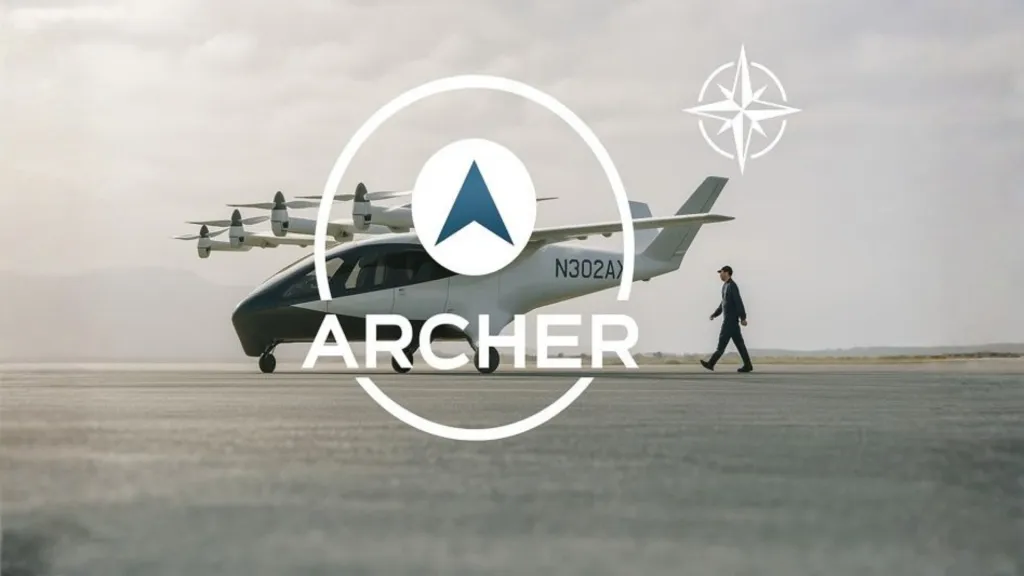
Investors are underwriting Archer’s ability to navigate FAA certification, scale manufacturing, secure infrastructure access, and preserve liquidity through a prolonged pre revenue period. The equity should be understood as an execution constrained asset rather than a thematic investment in urban air mobility as an abstract concept.
This distinction is fundamental. Aerospace history contains numerous examples of aircraft that flew successfully yet failed commercially due to certification delays, manufacturing breakdowns, or capital exhaustion. Archer has already cleared the conceptual and aerodynamic validation phase that dominates early eVTOL narratives.
The remaining work is less visible, more regulated, and far more determinative of long term equity outcomes. ACHR therefore trades primarily on progress through opaque regulatory milestones and on market confidence that management can avoid the structural failure modes common to early stage aerospace programs.
ACHR Stock News: Why 2025 to 2026 Is the Only Window That Matters
Recent Archer developments should be interpreted through the lens of time management rather than innovation. The reset of commercial passenger service expectations from 2025 into 2026 reflects the pace of FAA certification rather than deterioration in the underlying technical program. This delay is structural to the powered lift category and not unique to Archer. The central question is not whether timelines slip, but whether they slip in a way that erodes capital durability or forces compromised execution decisions.
Strategic actions taken during 2025 provide insight into management’s response to this constraint. The acquisition of Hawthorne Municipal Airport reflects an effort to control infrastructure variables that would otherwise sit outside Archer’s influence. The purchase of Lilium’s patent portfolio signals consolidation intent and technological optionality at a moment when competitors are failing. Defense engagement and international certification efforts serve a similar purpose. They provide alternative pathways for validation, relevance, and operational learning while the primary civilian certification process continues.
The eVTOL Industry Is Leaving the Concept Phase
The eVTOL sector is transitioning from demonstration to industrial accountability. Early differentiation based on novel propulsion concepts or extreme performance metrics is giving way to evaluation criteria centered on certifiability, manufacturability, and capital efficiency. The insolvency of several competitors highlights the reality that aerospace timelines are unforgiving and that access to capital is finite. Survivorship will be determined less by who flies first and more by who can certify, produce, and operate reliably under regulatory scrutiny.
This shift favors companies with strong balance sheets, credible industrial partners, and realistic mission profiles. Archer’s strategy reflects this transition. Its emphasis on pragmatic engineering, manufacturing leverage, and ecosystem control may appear conservative relative to early enthusiasm, but becomes increasingly relevant as certification timelines extend and capital markets demand discipline rather than ambition.
The Archer Aviation Investment Thesis
The investment thesis for Archer rests on three interlocking pillars. The first is technological pragmatism. Midnight was designed around existing battery technology and a distributed propulsion architecture optimized for redundancy and certifiability rather than maximum range or speed.
The second is manufacturing scalability through partnership rather than vertical integration. The Stellantis alliance shifts a meaningful portion of production risk away from Archer’s balance sheet while importing industrial discipline into aircraft manufacturing. The third is selective ecosystem control through infrastructure ownership and intellectual property consolidation, reducing reliance on third parties during early deployment.
The thesis fails if these pillars do not translate into tangible progress. Certification delays that extend materially beyond current expectations would increase capital pressure and dilution risk. Manufacturing ramps that underperform planned cadence would undermine the rationale for the Stellantis model. Infrastructure strategies that cannot scale beyond isolated hubs would constrain utilization and revenue potential. Each pillar therefore depends on disciplined execution rather than strategic intent.
Company Origins and Capital Formation
Archer was founded in 2018 with the explicit objective of accelerating development by avoiding speculative technology bets. Early design choices emphasized known components and system integration rather than experimental breakthroughs.
This philosophy enabled rapid progress through early validation phases and attracted high profile partners. The 2021 SPAC merger provided substantial capital but also exposed Archer to public market volatility before certification visibility was established. The subsequent valuation reset reflected a more realistic assessment of aerospace capital intensity rather than a repudiation of the business model.
Governance evolution has tracked this maturation. Leadership consolidation under a single chief executive coincided with Archer’s transition from concept validation to regulated execution. This shift often introduces tension between speed and discipline. Archer’s ability to navigate this phase without strategic drift will determine whether early momentum converts into durable enterprise value.
Leadership, Governance, and Operating Discipline
Archer’s leadership structure reflects the dual demands of aerospace execution and capital market management. The chief executive’s focus has increasingly centered on financing strategy, partnership alignment, and external stakeholder coordination.

Technical leadership drawn from prior eVTOL and traditional aerospace programs provides institutional knowledge around certification risk and regulator engagement. The CFO transition in 2025 occurred during a period of elevated spend but did not coincide with broader executive instability, suggesting organizational continuity.
The real test of governance lies ahead. As manufacturing expenses rise ahead of revenue, management will face tradeoffs between speed, cost, and dilution. Transparency and capital discipline during this phase will heavily influence investor confidence.
The Midnight Aircraft: Design for Certifiability
Midnight is engineered around a defined operational use case rather than generalized mobility. Its distributed electric propulsion system provides redundancy aligned with FAA safety expectations and reduces single point failure risk. Noise reduction is a core design parameter, reflecting the reality that urban adoption depends on community acceptance as much as technical performance. Archer’s reliance on commercially available cylindrical battery cells prioritizes thermal stability and supply chain reliability over marginal gains in energy density.
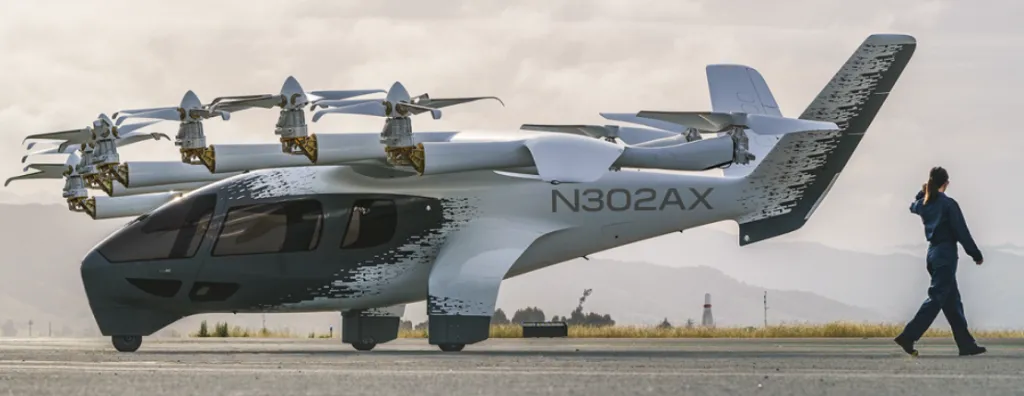
These choices constrain range and speed but align with the intended mission of frequent short hops between fixed nodes. The economic model assumes utilization and turnaround time drive returns more than extended range capability. This assumption will be tested in live operations, but it reflects a coherent view of early eVTOL network behavior.
ACHR vs JOBY: Two Engineering Philosophies
Comparisons between Archer and Joby highlight divergent approaches to the same regulatory environment. Joby has prioritized performance metrics such as range and cruise speed and has advanced further in FAA Stage 4 testing.
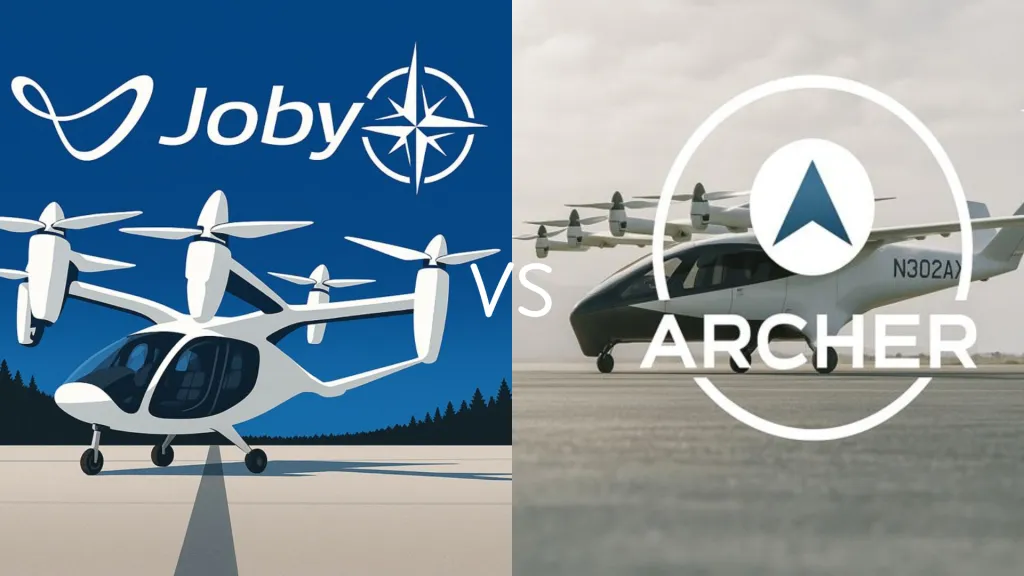
Archer has accepted lower performance ceilings in exchange for manufacturing simplicity and payload optimization. These choices imply different risk profiles. Joby’s approach may enable broader route flexibility but introduces greater complexity in production and certification. Archer’s narrower mission set reduces technical ambition but may lower execution risk.
Certification lead alone does not determine commercial success. Manufacturing scalability, capital efficiency, and infrastructure integration ultimately drive sustainable operations. Archer’s strategy assumes that being second to certify remains viable if production and deployment are executed more efficiently.
Manufacturing Strategy and the Stellantis Partnership
Archer’s manufacturing strategy is anchored by its partnership with Stellantis, which serves as exclusive contract manufacturer. Stellantis funds a significant portion of labor costs and initial capital expenditures, reimbursed through equity issuance tied to production activity. This structure preserves Archer’s cash during certification while embedding automotive scale manufacturing processes into aircraft production. The tradeoff is ongoing dilution, which must be weighed against reduced insolvency risk.
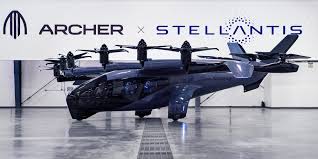
The success of this model depends on proportionality. If dilution tracks value creation through certification and deployment, the partnership represents a structural advantage. If production ramps without corresponding operational progress, dilution becomes a persistent headwind.
The Georgia Production Facility
The Covington, Georgia facility represents Archer’s transition from prototype assembly to serial production. Designed for phased expansion, the site reflects realistic assumptions around certification pacing and early demand. The Golden Line approach validated processes at low volume before replication, reducing ramp risk. Early production cadence rather than theoretical capacity will determine whether Archer’s manufacturing thesis holds.
FAA Certification Pathway
Archer is certifying its Midnight aircraft under the FAA’s powered lift framework, a regulatory category designed for aircraft that do not fit neatly into traditional airplane or rotorcraft classifications. This framework is still relatively young in practice, which introduces an additional layer of uncertainty beyond the already demanding nature of aerospace certification.
Completion of the airworthiness criteria and means of compliance established the formal rulebook governing Midnight’s certification, but these milestones should be understood as necessary prerequisites rather than indicators of proximity to approval.
The current focus of Archer’s certification effort is Phase 4 testing, which represents the execution of agreed upon test plans under FAA oversight. This phase is resource intensive and iterative, involving extensive ground testing, flight testing, data collection, and documentation.
Progress through Phase 4 is inherently incremental and often opaque to external observers because individual test results, retests, and refinements are not disclosed in real time. As a result, public signals tend to lag underlying effort, creating a disconnect between operational reality and market perception.
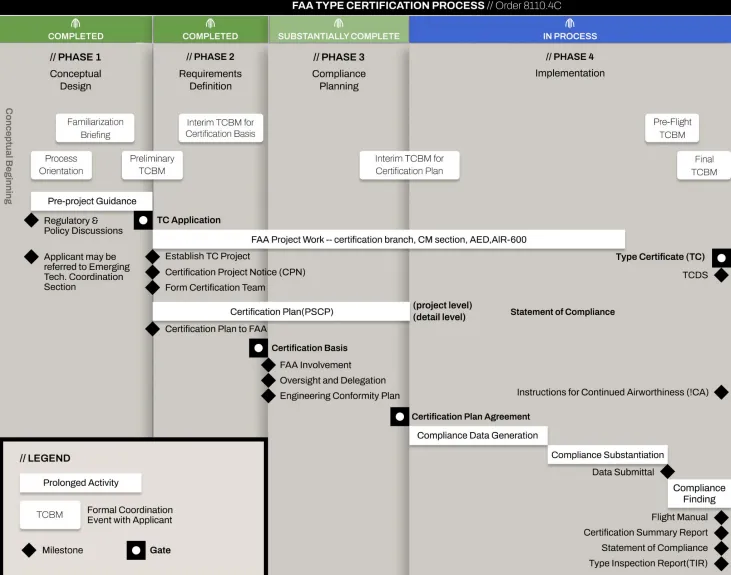
Entry into Type Inspection Authorization is a critical inflection point, as it allows FAA pilots to conduct for credit testing of the aircraft. However, TIA should not be viewed as a binary gateway to certification. It marks a transition in oversight intensity rather than an endpoint.
Even after TIA begins, certification remains contingent on satisfactory performance across the full spectrum of required tests and analyses. Findings during this stage can prompt design changes, additional testing, or revised compliance demonstrations, all of which can affect timelines.
Certification outcomes are also influenced by factors beyond Archer’s direct control. FAA staffing capacity, internal prioritization, and broader industry context all play roles in pacing. A safety incident involving another powered lift or advanced aircraft could trigger heightened scrutiny across the category, slowing progress regardless of Archer’s individual performance.
For investors, the key takeaway is that certification should be treated as probabilistic rather than deterministic. Progress matters, but timelines remain subject to revision until final approval is granted.
Operational Certifications and Airline Readiness
Aircraft certification alone is insufficient for commercial service. Archer must also demonstrate that it can operate safely and reliably within the broader aviation system. To this end, the company has secured Part 135 certification, authorizing it to operate as a commercial air carrier, and Part 141 certification, allowing it to run an approved pilot training program. These approvals enable Archer to build operational capability in parallel with aircraft certification rather than waiting for final approval before preparing its airline infrastructure.
Part 135 certification allows Archer to develop and validate operating procedures, maintenance programs, dispatch protocols, and safety management systems using conventional aircraft. This preparatory work is critical because it reduces the risk of operational bottlenecks once Midnight enters service.
It also provides regulators with evidence that Archer can function as an air operator, not just an aircraft developer. Similarly, Part 141 certification addresses one of the most underappreciated constraints in advanced air mobility, which is pilot availability. Powered lift aircraft require specialized training, and the broader aviation industry already faces pilot shortages.
Despite these preparations, operational readiness remains a complex challenge. Integrating eVTOL operations into existing air traffic management systems requires coordination with the FAA, airport authorities, and local stakeholders. Procedures for vertiport operations, charging logistics, passenger handling, and contingency management must be validated in real environments. Early scalability will therefore be constrained not only by aircraft availability but also by the ability of surrounding systems to absorb a new class of operations without compromising safety or efficiency.
From an investment perspective, these operational certifications should be viewed as risk mitigation rather than growth catalysts. They reduce the likelihood of post certification delays but do not guarantee smooth scaling. The transition from demonstration routes to repeatable service will depend on how effectively Archer can integrate people, processes, and infrastructure under regulatory supervision.
Flight Test Progress and Validation Milestones
Archer’s flight test program has advanced steadily over the past several years, culminating in key milestones such as full transition flight, extended range sorties, and high altitude operations.
These achievements demonstrate that Midnight’s propulsion system, flight controls, and energy management architecture function across a meaningful portion of the intended operating envelope. However, flight test milestones should not be interpreted as linear progress toward commercialization. They are inputs into a broader certification process rather than endpoints in themselves.
At this stage, the primary objective of flight testing is data accumulation for certification credit. Each flight is designed to validate specific performance, safety, or reliability criteria defined in the means of compliance. High sortie rates and repeatability under controlled conditions are therefore more important than record setting flights or headline metrics. Regulators care less about peak performance than about consistency, fault tolerance, and system behavior under off nominal conditions.
As Archer moves deeper into for credit testing, the operational tempo of its flight test program becomes increasingly relevant. The ability to conduct multiple flights per day, manage battery turnaround efficiently, and operate within defined parameters provides evidence that the aircraft can sustain commercial duty cycles. Conversely, interruptions, anomalies, or inconsistent results can introduce delays that compound over time.
Investors should interpret flight test progress through this lens. The absence of dramatic announcements does not imply stagnation, and high profile milestones do not imply imminent approval. What matters is sustained execution without adverse findings.
In regulated aerospace programs, progress is often quiet, nonlinear, and only visible in hindsight. Archer’s flight test trajectory to date suggests technical robustness, but certification credit will ultimately depend on the cumulative body of evidence rather than any single achievement.
How Flight Testing, Certification, and Operations Converge
Flight testing, certification, and commercial operations are often discussed as separate phases, but in practice they form a tightly coupled system where progress in one domain only matters insofar as it unlocks progress in the next. Flight testing is not undertaken to prove that the aircraft can fly, that question has already been answered.
Its purpose is to generate regulator accepted evidence that the aircraft behaves predictably, safely, and repeatably across defined operating conditions. That evidence feeds directly into the FAA’s certification determinations, which in turn gate when and how the aircraft can be introduced into service.
Certification does not simply authorize flight. It constrains operations by defining approved envelopes, maintenance intervals, training requirements, and failure tolerances. These constraints shape Archer’s early operating model, influencing route selection, utilization rates, pilot scheduling, and infrastructure needs. Operational readiness therefore cannot be decoupled from certification outcomes. Procedures, staffing, and systems built under Part 135 and Part 141 must align precisely with the limitations imposed by the final type certificate, or they will require revision.
This interdependence has direct financial implications. Delays or findings in flight testing propagate into certification timelines, which in turn defer revenue generation and extend cash burn. Conversely, smooth execution through testing and certification compresses time to deployment, allowing capital to be converted into operational learning rather than consumed by waiting. Archer’s strategy of preparing operations in parallel with certification reflects an attempt to shorten this handoff, but it does not eliminate the fundamental sequencing constraint.
For investors, this means progress should be evaluated holistically. Flight test updates, regulatory milestones, and operational preparations are not independent signals. They are components of a single execution pipeline. The equity outcome depends not on excellence in any one area, but on Archer’s ability to move all three forward together without introducing friction that compounds delay or capital strain.
ACHR Commercial Launch Strategy
Archer’s commercial launch strategy is built around controlled validation rather than rapid expansion. Management is treating launch as an execution stress test conducted under live regulatory and operational conditions, not as a revenue inflection point.
This posture reflects a realistic understanding of certification constraints, infrastructure readiness, and capital efficiency. For Archer, early commercial service is a mechanism to convert regulatory approval into operational credibility, not a moment to maximize visibility or scale.
United States Launch: Controlled Demonstration Corridors
In the United States, Archer’s initial commercial routes are designed to demonstrate reliability, safety, and time savings rather than immediate profitability. Partnerships with United Airlines focus on airport to city center corridors such as Newark to Manhattan and O’Hare to downtown Chicago. These routes are deliberately selected because they concentrate demand, minimize routing complexity, and leverage existing aviation infrastructure.
Operationally, these corridors allow Archer to tightly manage variables such as airspace coordination, vertiport logistics, maintenance access, and passenger flow. The objective is to validate dispatch reliability, turnaround times, noise performance, and integration with existing airline operations. Early success on these routes would provide regulators, municipalities, and future partners with tangible evidence that eVTOL service can function predictably within dense urban environments.
International Launch: Regulatory Alignment and Early Adoption
Internationally, Archer is prioritizing markets where regulatory coordination and infrastructure deployment can proceed more efficiently than in the United States. The United Arab Emirates represents the most advanced example of this strategy. Centralized decision making, strong government backing, and willingness to invest in enabling infrastructure create a more predictable environment for early commercial operations.
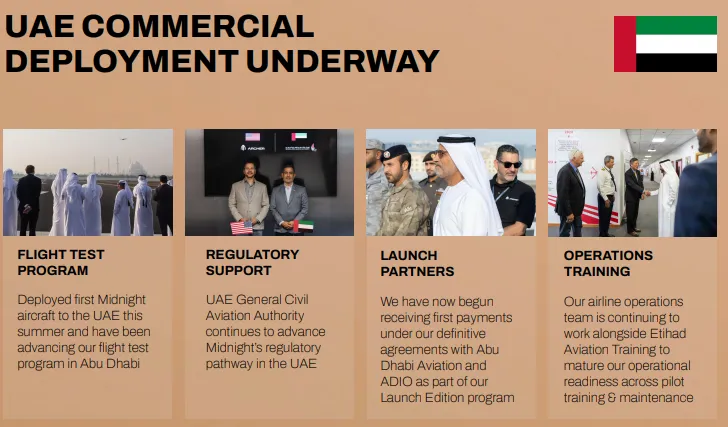
Planned routes between Abu Dhabi and Dubai are intended to demonstrate intercity viability rather than short novelty flights. Pricing targets position the service as a premium alternative to ground transportation, reflecting realistic early economics. The strategic value of this launch lies less in near term margin contribution and more in generating real world operational data under commercial conditions that can inform broader deployment and regulatory confidence elsewhere.
Selective Market Expansion and Demand Signaling
Other international partnerships, including those in Japan and additional densely populated markets, function primarily as demand signaling and long term optionality rather than near term launch commitments. These regions offer compelling congestion driven use cases, but regulatory alignment, infrastructure readiness, and public acceptance vary significantly.
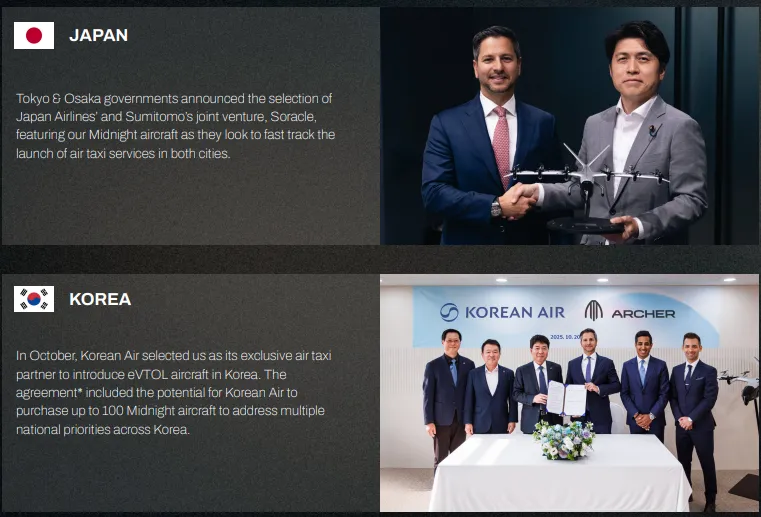
Archer’s decision to avoid simultaneous launches across multiple geographies reflects an understanding that early operational failures carry disproportionate regulatory and reputational risk. Expansion is therefore sequenced, with lessons from initial markets informing later deployments. This approach limits early revenue scale but reduces the probability of missteps that could delay or derail broader adoption.
Deployment Constraints and Utilization Discipline
A defining feature of Archer’s launch strategy is the tight coupling between aircraft availability, pilot readiness, and infrastructure access. Commercial deployment cannot outpace certification constraints or training throughput. As a result, early utilization rates are expected to be intentionally conservative.
Aircraft will be deployed where charging logistics, maintenance support, and regulatory oversight can be tightly controlled. This constrains scale but supports reliability. Over time, utilization can increase as confidence builds across regulators, operators, and municipalities. Early discipline in deployment is critical because operational incidents in the launch phase would have cascading effects on certification confidence and expansion timelines.
Financial Implications of Early Commercial Operations
From a financial perspective, early commercial launch should be viewed as a controlled cost center rather than a profit driver. Operating expenses will rise as Archer staffs flight operations, maintenance, safety oversight, and customer support. Initial revenue will offset only a portion of these costs and should not be interpreted as a path to near term profitability.
The financial payoff of launch lies in de risking rather than cash generation. Each successful commercial operation converts uncertainty into evidence, improving capital market confidence and reducing the discount applied to future scale. In this sense, launch expenditures function as high leverage validation investments rather than growth spending.
Key Signals for Investors
For investors, the most important indicators during Archer’s launch phase will not be route count or passenger volume. Consistency will matter far more than scale. On time departures, predictable turnaround times, regulator comfort, and absence of safety or community noise incidents will determine whether Archer earns the right to expand.
A measured launch that appears slow on the surface can be strategically superior to aggressive expansion that introduces fragility. Archer’s commercial launch strategy reflects an understanding that in regulated aerospace, credibility compounds slowly while failure compounds quickly. That tradeoff sits at the center of the long term equity thesis.
Infrastructure and Ecosystem Control
Infrastructure is one of the most underestimated constraints in the eVTOL investment landscape. Aircraft certification alone does not create a viable service. Electric vertical aviation requires physical locations to land, charge, maintain, and stage aircraft, as well as integration with existing airspace, utilities, and municipal systems. Archer’s strategy reflects an understanding that without partial control over these variables, even a certified aircraft risks being stranded by external bottlenecks.
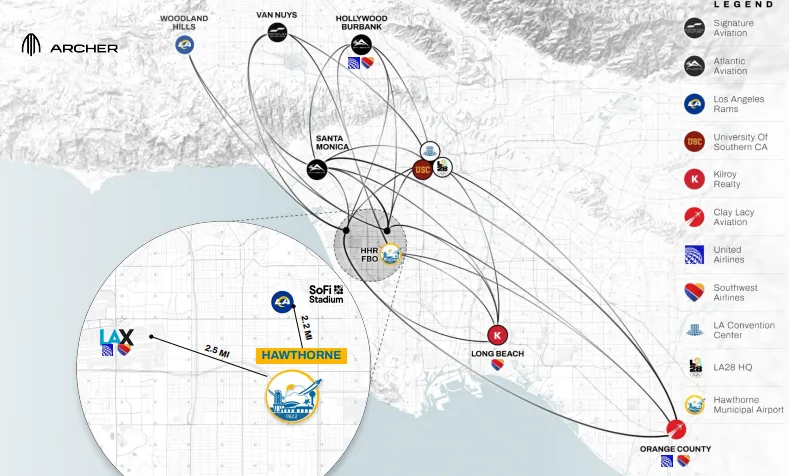
Rather than assuming infrastructure will emerge organically, Archer has taken steps to internalize critical nodes of the ecosystem where feasible and to align closely with partners and governments where ownership is impractical. This approach prioritizes reliability and learning over theoretical scalability, which is appropriate for an industry entering its first commercial phase.
Vertiports, Airports, and Physical Access
Access to suitable landing and staging locations is a primary gating factor for early eVTOL deployment. Archer’s acquisition of Hawthorne Municipal Airport represents a strategic departure from reliance on third party fixed base operators and municipal access agreements. By owning a full scale airport facility, Archer secures guaranteed access to runways, terminal space, hangars, and adjacent land for future vertiport conversion.
This ownership structure provides operational flexibility that is difficult to replicate through leasing or partnership alone. It allows Archer to design passenger flow, maintenance operations, and ground handling procedures without negotiating each modification through external stakeholders. It also creates a controlled environment for iterative improvement, where operational lessons can be tested and refined before being applied to third party locations.
However, ownership is not a universally scalable model. Archer is unlikely to own the majority of its future operating locations. Instead, Hawthorne should be viewed as a flagship and laboratory that informs standards for future vertiports developed in partnership with airports, municipalities, and private infrastructure operators.
Energy and Grid Integration
Electric aviation introduces a new category of infrastructure dependency in the form of high capacity power delivery. Rapid turnaround operations require fast charging systems capable of delivering large amounts of energy reliably and repeatedly. This places Archer’s operations at the intersection of aviation and local electrical grids, which are often constrained, regulated, and slow to upgrade.
By controlling key sites such as Hawthorne, Archer gains the ability to work directly with utilities to design and deploy charging infrastructure without landlord interference. This enables experimentation with load management, energy storage, and charging schedules that will be critical to achieving acceptable utilization rates. In third party locations, Archer will remain dependent on airport authorities and utilities, making site selection and sequencing essential.
Grid readiness will likely constrain early network density. Archer’s strategy implicitly acknowledges this by focusing initial operations on a small number of high value corridors rather than attempting broad geographic coverage. Over time, infrastructure standards developed at controlled sites can be used to accelerate deployment elsewhere, but grid coordination will remain a limiting factor.
Airspace Integration and Local Coordination
Unlike conventional aviation, eVTOL operations occur at lower altitudes and in closer proximity to dense population centers. This requires careful coordination with air traffic control, local governments, and community stakeholders. Noise, visual presence, and perceived safety all influence whether operations are permitted to expand.
Archer’s emphasis on low acoustic signature aircraft is a necessary but insufficient condition for acceptance. Operating procedures, flight paths, and scheduling must be designed in coordination with regulators and municipalities. Early operations in controlled corridors allow Archer to establish precedent and trust, which can then be leveraged when negotiating access in more complex environments.
Failure to manage these relationships effectively would impose hard limits on expansion regardless of aircraft availability. Infrastructure control therefore extends beyond physical assets to include institutional relationships and regulatory credibility at the local level.
Operational Software and Systems Integration
Infrastructure is not purely physical. Archer’s ecosystem includes digital systems that coordinate aircraft scheduling, charging, maintenance, and passenger flow. As operations scale, these systems become critical to utilization and reliability. While less visible than aircraft or vertiports, operational software determines whether a network functions efficiently or degrades under complexity.
Controlled environments such as Hawthorne provide a proving ground for these systems. By integrating software with owned infrastructure, Archer can optimize operations holistically rather than adapting to fragmented third party systems. This integration advantage compounds over time, particularly as autonomous or semi autonomous operations become feasible.
Strategic Implications for Scale
Archer’s infrastructure strategy deliberately trades speed for control in the early stages. This limits near term scale but reduces the probability of operational failure that could stall the entire program. As standards mature and confidence builds, infrastructure requirements may become more modular and replicable, enabling faster expansion through partnerships rather than ownership.
For investors, infrastructure control should be viewed as a risk mitigation strategy rather than a growth lever. It does not guarantee success, but it meaningfully reduces the likelihood that certification and aircraft readiness outpace the environment required to support them. In a sector where external dependencies can quietly derail otherwise sound programs, Archer’s proactive approach to infrastructure represents a disciplined attempt to align technology, regulation, and operations into a coherent system.
Strategic Partnerships and Ecosystem Alignment
At this stage of Archer’s development, partnerships are not peripheral. They function as extensions of capital discipline, execution capacity, and regulatory credibility. In early aerospace programs, the absence of high quality partners often forces companies to solve too many hard problems simultaneously, accelerating failure rather than progress. Archer’s partnership strategy reflects an understanding that certification timelines are uncertain and that survivability depends on distributing risk across industrial, commercial, and government aligned counterparties. The depth and structure of these relationships matter far more than headline quantity, particularly as the company navigates its most capital intensive and regulator dependent phase.
Stellantis: Manufacturing Leverage and Industrial Discipline
The partnership with Stellantis underpins Archer’s manufacturing thesis and is central to its attempt to avoid the production failures that have historically destroyed aerospace startups. Stellantis serves as Archer’s exclusive contract manufacturer, funding a significant portion of labor costs and initial manufacturing capital expenditures in exchange for equity issuance tied to production activity. This structure preserves Archer’s cash during the certification phase while embedding automotive scale manufacturing processes into aircraft production. Stellantis personnel are integrated across Archer’s supply chain, quality control, and manufacturing engineering functions, importing decades of experience in tolerance management, automation, and process repeatability.
The strategic importance of this partnership lies in risk transfer rather than cost minimization. Archer is effectively trading dilution for a higher probability of manufacturing success. This tradeoff is rational in a sector where cash exhaustion is often terminal. The partnership does not guarantee production efficiency, but it meaningfully reduces the likelihood that Archer encounters catastrophic manufacturing bottlenecks during ramp. The long term equity impact will depend on whether dilution remains proportional to value creation rather than compounding ahead of operational progress.
Anduril Industries and ACHR
The partnership with Anduril Industries represents a critical source of strategic optionality rather than near term revenue. Anduril is a software first defense technology company specializing in autonomous systems, sensor fusion, and command and control platforms.

Its Lattice software integrates diverse assets into a unified operational environment, enabling autonomous or semi autonomous mission execution at scale. By aligning with Anduril, Archer positions its aircraft within a defense ecosystem that prioritizes modularity, rapid deployment, and software defined capability over bespoke airframe design cycles.
This relationship introduces several meaningful pathways. First, it enables exploration of autonomous or remotely operated logistics missions, which materially alters payload capacity, risk exposure, and unit economics by removing the pilot from the aircraft. Second, it aligns Archer with the Department of Defense’s evolving procurement philosophy, which increasingly favors scalable autonomous systems over limited numbers of specialized platforms. Third, it provides signaling value. Anduril’s willingness to invest engineering effort into integration suggests confidence that Archer’s systems architecture is sufficiently mature to support advanced autonomy layers.
While the partnership does not imply guaranteed defense procurement, it materially improves Archer’s credibility within national security circles. That credibility can translate into expanded testing opportunities, non dilutive funding, and influence in regulatory discussions around autonomy and operational concepts. In an environment where civilian certification timelines remain uncertain, this form of optionality meaningfully expands Archer’s range of viable outcomes.
AFWERX and U.S. Department of Defense Programs: Validation and Non Dilutive Progress
Archer’s participation in AFWERX programs provides a complementary form of defense engagement focused on experimentation and operational validation. Through these contracts, Archer has delivered aircraft to the U.S. Air Force for evaluation in logistics, medical evacuation, and personnel transport scenarios. These missions stress reliability, acoustic discretion, thermal management, and operational robustness under demanding conditions.
The value of AFWERX engagement lies in its ability to generate flight hours, operational data, and institutional familiarity without requiring immediate commercial deployment. Defense testing contributes to system maturity and data accumulation that can support civilian certification efforts.
It also provides Archer with a pathway to remain operationally relevant even if commercial timelines extend. While defense revenue is unlikely to approach civilian scale, it serves as a stabilizing force during the most uncertain phase of the company’s lifecycle.
United Airlines: Commercial Demand Signaling and Operational Integration
Archer’s partnership with United Airlines serves as both a demand signal and an operational proving ground. United’s involvement extends beyond aircraft orders into route planning, infrastructure coordination, and customer integration. This matters because many early aviation programs fail when theoretical performance does not translate into schedulable, reliable service within airline operations.

United’s continued engagement suggests that Archer’s mission profile aligns with realistic use cases, particularly airport to city center transfers where time savings are most compelling. The partnership also provides Archer with early insight into airline operational requirements, including dispatch reliability, maintenance integration, and customer experience considerations. While United’s participation does not eliminate execution risk, it materially improves Archer’s ability to design an aircraft and operating model that fits within existing aviation ecosystems.
ACHR International Partnerships
Archer’s international partnerships, particularly in the United Arab Emirates and Japan, reflect a pragmatic approach to regulatory and market access risk. Different jurisdictions exhibit materially different regulatory postures toward eVTOL operations.
The UAE offers a centralized decision making environment with strong government support for infrastructure deployment and innovation. Success in this market would provide early commercial validation and operational data under real world conditions.
Partnerships in Japan and other regions function primarily as demand validation and future growth options. They signal interest from sophisticated operators in densely populated markets with acute congestion challenges. However, these partnerships remain contingent on certification progress and infrastructure readiness. Their strategic value lies in diversification rather than immediate scale.
ACHR Financial Position and Liquidity
Archer’s financial position is one of its most important strategic differentiators within the eVTOL landscape. Unlike many peers that are operating close to capital constraints, Archer enters the final stages of certification with a balance sheet designed to absorb delay, iteration, and regulatory friction.
As of late 2025, the company holds approximately 1.64 billion dollars in cash, cash equivalents, and short term investments. This liquidity position reflects aggressive capital raising over the past two years and management’s explicit prioritization of survivability over near term dilution sensitivity.

At current operating levels, Archer’s quarterly cash burn is approximately 130 million dollars. This figure reflects simultaneous spending on research and development, flight testing, certification activities, early manufacturing ramp, and organizational build out. On a simple arithmetic basis, this implies runway extending into 2027 or 2028. However, such linear extrapolation understates the complexity of Archer’s spend profile. Cash burn is unlikely to remain static. As production of conforming aircraft accelerates, infrastructure investments expand, and early commercial operations commence, absolute cash outflows will increase even if capital efficiency improves.
A critical feature of Archer’s financial architecture is the Stellantis equity for labor arrangement. Under this structure, Stellantis funds a significant portion of manufacturing labor costs and certain capital expenditures, with reimbursement occurring through periodic equity issuance rather than cash payments.
This mechanism materially preserves Archer’s cash during the certification window, effectively converting fixed manufacturing costs into a form of variable equity financing. From a solvency perspective, this is a meaningful advantage. It reduces the probability that Archer is forced into distressed capital raises during periods of regulatory delay.
The tradeoff is structural dilution. As production activity increases, so too does equity issuance to Stellantis. This creates a dynamic where shareholder dilution is directly tied to manufacturing progress rather than revenue generation. In early stages, this can pressure per share value even as enterprise value improves. The sustainability of this model depends on timing.
If certification clarity and commercial deployment follow closely behind production ramp, dilution is absorbed by rising operational credibility. If production activity advances materially ahead of deployment, dilution can compound without corresponding value realization.
Beyond the Stellantis arrangement, Archer has demonstrated a willingness to access capital markets proactively rather than defensively. Recent equity raises were executed from a position of relative strength, allowing the company to secure liquidity well ahead of existential need.
This approach contrasts with historical aerospace failures, where capital was raised reactively after setbacks, often at punitive valuations. Archer’s current cash balance provides management with negotiating leverage, optionality in pacing expenditures, and the ability to absorb unforeseen regulatory or operational costs without immediate recourse to the market.
That said, Archer remains a pre revenue company with no near term self funding mechanism. Even under optimistic scenarios, early commercial operations are unlikely to generate cash flow sufficient to offset operating expenses for several years.
As a result, capital discipline remains paramount. Management must continuously balance the desire to accelerate progress against the risk of exhausting balance sheet flexibility. Decisions around production cadence, infrastructure ownership, and international expansion will each have direct capital implications.
From an investor perspective, Archer’s financial position should be viewed less as a static runway calculation and more as a probability buffer. The balance sheet does not guarantee success, but it materially increases the number of iterations Archer can survive while working through certification and early deployment.
In a sector where timing uncertainty is endemic, that buffer meaningfully alters the risk distribution. The central financial question for ACHR is therefore not whether it has enough cash today, but whether it can convert liquidity into irreversible progress before dilution erodes the equity’s long term attractiveness.
Valuation Context and Market Expectations
Archer’s valuation reflects both its cash position and execution uncertainty. Peer comparisons based on projected revenue multiples obscure differences in capital structure and certification progress. Valuation will move primarily with changes in perceived probability of successful certification and scalable deployment.
ACHR Stock Forecast: Scenario Driven Outcomes
Forecasting Archer Aviation requires abandoning traditional growth equity models. There is no meaningful revenue base to extrapolate, no stable margin structure to optimize, and no near term cash flow inflection to discount.
Instead, ACHR’s equity value over the next several years will be driven by changes in perceived probability across a small number of gating milestones. Certification progress, manufacturing cadence, infrastructure readiness, and capital discipline each act as binary or semi binary variables that shift the distribution of outcomes rather than produce linear improvement.
The appropriate forecast framework therefore centers on execution scenarios rather than explicit price targets. Each scenario below defines the operational conditions under which Archer’s equity would likely trade, focusing on what must occur, what fails to occur, and how capital markets would respond.
ACHR Bear Case: Certification Slippage and Capital Compression
In the bear scenario, Archer experiences material delays during the latter stages of FAA Phase 4 testing or encounters additional requirements during Type Inspection Authorization that extend the certification timeline well beyond current expectations. These delays are not necessarily the result of technical failure but may stem from regulator capacity constraints, evolving interpretation of powered lift standards, or industry wide caution following external safety incidents. Certification drift pushes meaningful commercial operations out several years, materially extending the pre revenue period.
As timelines stretch, manufacturing ramp slows or pauses to avoid producing aircraft that cannot be deployed. The Stellantis equity for labor mechanism continues to introduce dilution without corresponding operational leverage. Infrastructure investments become harder to justify in the absence of clear deployment timelines. Capital markets grow less tolerant of prolonged execution uncertainty, forcing Archer to raise additional capital at depressed valuations or further expand dilution mechanisms.
In this scenario, ACHR trades less on future market potential and more on balance sheet optionality. Equity value becomes anchored to cash reserves and residual option value rather than execution confidence. The stock underperforms not because the technology fails, but because time and capital costs overwhelm progress.
ACHR Base Case: Incremental Progress and Controlled Dilution
The base case assumes Archer continues to make steady but uneven progress through FAA Phase 4 and enters Type Inspection Authorization on a delayed but manageable timeline. Certification is achieved later than early expectations but without major adverse findings. Initial production of conforming aircraft proceeds cautiously, with manufacturing cadence intentionally constrained to align with regulatory and operational readiness.
Commercial launch begins in limited form, likely first in international markets such as the UAE where regulatory coordination and infrastructure deployment are more centralized. U.S. operations follow at modest scale, focused on demonstration routes rather than network density. Revenue remains limited in the early years, but operational data accumulation improves confidence in system reliability and economics.
Capital discipline remains intact but dilution persists through the Stellantis structure and incremental funding needs. Equity performance in this scenario is range bound, driven by milestone updates rather than financial results. The stock gradually reprices upward as execution risk declines, but does not experience dramatic revaluation until production and utilization demonstrate repeatability.
ACHR Bull Case: Certification Clarity and Scalable Execution
In the bull scenario, Archer completes Phase 4 testing without material setbacks and enters Type Inspection Authorization within a timeframe that preserves balance sheet flexibility. Certification is achieved with minimal incremental requirements, allowing production of conforming aircraft to proceed without pause. Manufacturing cadence ramps in Georgia in line with planned milestones, validating the Stellantis partnership as an effective industrialization model.
Commercial operations launch successfully in the UAE and expand into U.S. trunk routes with United Airlines, demonstrating reliability, turnaround efficiency, and acceptable unit economics. Infrastructure investments at controlled hubs such as Hawthorne translate into high utilization rates and operational learning advantages. Defense and autonomy partnerships continue to provide optionality but remain additive rather than necessary for survivability.
In this scenario, capital markets reward Archer for execution clarity rather than speculative potential. The equity begins to trade on forward deployment capacity and production throughput rather than certification risk. Valuation expands as probability weighted outcomes compress toward success, and dilution becomes increasingly offset by tangible operational value creation.
Key Risks and Structural Uncertainties
Archer’s long term outcome is governed less by market demand than by a sequence of external and internal constraints that must be satisfied in the correct order. Many of these risks are not binary and do not resolve cleanly. They compound over time and interact with one another, particularly around certification, capital allocation, and operational scaling. Investors should evaluate ACHR as an execution constrained asset rather than a growth equity, and the risks below should be viewed as probability shapers rather than hypothetical edge cases.
Regulatory and Certification Risk
Regulatory risk is the dominant factor governing Archer’s timeline and valuation. The FAA retains absolute authority over certification outcomes, and the powered lift framework under which Midnight is being certified remains relatively new. Even with completed airworthiness criteria and means of compliance, the interpretation and enforcement of those standards occur during Phase 4 testing and Type Inspection Authorization. This process is inherently iterative and subject to change based on test results, regulator staffing capacity, and broader industry events.
A critical aspect of this risk is that Archer’s progress is not evaluated in isolation. A safety incident involving any eVTOL aircraft could prompt the FAA to reassess assumptions, slow approvals, or introduce additional requirements across the category. This systemic exposure means Archer can execute competently and still suffer delays driven by external failures. Certification slippage beyond current expectations would extend the pre revenue period, increase capital consumption, and heighten dilution risk.
Execution and Manufacturing Risk
Manufacturing risk emerges once certification and production intersect. Archer’s strategy relies on transitioning from prototype assembly to serial production without encountering the quality control and process failures that historically derail aerospace programs. While the Stellantis partnership mitigates some of this risk, it does not eliminate it. Aircraft manufacturing tolerances, supplier reliability, and process validation must all scale in parallel, often under regulatory observation.
A failure to achieve planned production cadence would have cascading effects. Delayed deliveries reduce operational learning, slow revenue generation, and weaken the justification for continued dilution through equity for labor arrangements. Manufacturing setbacks are particularly dangerous because they tend to surface late, after substantial capital has already been committed.
Capital Structure and Dilution Risk
Archer’s balance sheet is strong relative to peers, but its capital structure embeds ongoing dilution through equity issuance tied to manufacturing labor. This structure preserves cash but shifts risk onto shareholders. If certification or production timelines extend, dilution can accumulate without corresponding value creation. In such a scenario, even technical progress may fail to translate into per share gains.
Access to capital markets is another variable. Archer’s ability to raise funds on acceptable terms depends on market sentiment toward pre revenue aerospace and on confidence in management’s execution. A risk off environment or sector wide sentiment shift could compress valuation and increase the cost of additional capital, further pressuring shareholder value.
Infrastructure and Grid Dependency Risk
Archer’s commercial viability depends on access to suitable landing, charging, and grid infrastructure. While ownership of Hawthorne Municipal Airport provides control in one key market, most future deployments will rely on third party airports, municipalities, and utilities. Electrification upgrades at major hubs such as Newark, O’Hare, and LAX involve long planning cycles, regulatory approvals, and public investment coordination.
Delays or opposition at the infrastructure level can stall route launches even after aircraft certification. This risk is difficult to hedge because it sits outside Archer’s direct control and varies by jurisdiction. Infrastructure bottlenecks could limit utilization rates and delay network effects, undermining early revenue assumptions.
Operational and Human Capital Risk
Operating an air taxi network introduces complexity beyond aircraft performance. Dispatch reliability, maintenance procedures, pilot scheduling, and passenger handling must all function seamlessly to meet safety and regulatory expectations. Pilot availability represents a structural constraint, particularly for powered lift aircraft that require specialized training. Archer’s Part 141 certification mitigates this risk but does not eliminate it.
Human capital risk extends to engineering and regulatory expertise. Certification programs rely on institutional knowledge and continuity. Loss of key personnel during critical phases can introduce delays that are difficult to recover from. Retaining talent through a prolonged pre revenue period requires both financial and cultural stability.
Technology and Obsolescence Risk
Archer’s design philosophy prioritizes certifiability over maximum performance. This is rational in the near term but introduces longer term risk if competing platforms achieve meaningful breakthroughs in energy density or propulsion efficiency. Advances such as solid state batteries or alternative energy systems could render Midnight’s range limitations commercially disadvantageous in certain markets.
While Archer has partially hedged this risk through intellectual property acquisition and modular architecture, technology transitions in aerospace tend to be slow and capital intensive. The risk is not immediate obsolescence but gradual erosion of relative competitiveness over a decade long horizon.
Litigation and Competitive Risk
The competitive landscape includes ongoing legal disputes, including litigation with Joby related to trade secrets and real estate matters. While outcomes are uncertain, prolonged litigation consumes management attention, increases costs, and introduces reputational risk. Competitive pressures may also intensify as surviving players consolidate market share and influence regulatory narratives.
Competition is not limited to other eVTOL manufacturers. Traditional helicopter operators, infrastructure providers, and even ground transportation alternatives will shape pricing and adoption dynamics. Archer must compete not only on performance but on reliability, cost, and regulatory compliance.
Macroeconomic and Political Risk
Macroeconomic conditions influence capital availability, public spending on infrastructure, and political tolerance for experimental transportation systems. Rising interest rates or fiscal tightening could reduce appetite for long duration speculative investments and delay public infrastructure projects. Political shifts could alter regulatory priorities or funding support for advanced air mobility initiatives.
International operations introduce additional geopolitical risk. Regulatory alignment, currency exposure, and political stability vary across markets. While diversification can reduce dependence on any single jurisdiction, it also increases complexity.
Is ACHR Stock a Buy?
Archer Aviation now occupies the narrow zone where aerospace companies either mature into durable operators or fail quietly despite years of technical progress. The company has cleared the conceptual hurdles and now faces the harder task of executing under regulatory, industrial, and capital constraints simultaneously. What distinguishes Archer is strategic realism rather than technological bravado. Partnerships, infrastructure control, and capital discipline all reflect an understanding that survivability matters more than speed.
ACHR should be evaluated as a milestone driven execution asset rather than a growth narrative. The next twenty four to thirty six months will determine whether Archer can complete certification, transition into repeatable production, and begin operating aircraft safely and reliably in live environments.
Success will not be dramatic, and failure will not be sudden. That is the nature of regulated aerospace. Archer represents a credible attempt to navigate this reality, and the equity should be sized and assessed accordingly.

Archer Aviation Stock
Archer Aviation stock gives you access to a pioneer in urban air transport. Flying cars are no longer the future, they are today.

Celsius Stock Analysis: The Shelf Reset and the Second Growth Curve
Celsius stock analysis of the shelf reset, Alani growth, Pepsi economics and cash flow, with a 2030 model and a Premium valuation and entry-price framework.

Meta AI Spending: The Customer Is Already Here
Can Meta turn AI spending into shareholder returns? We model advertising, Muse, hardware, capital costs and cash flow through 2030, with a full valuation.
Northwise Portfolios
See how the research becomes real decisions
Reader discussion
Discuss the research
Create a Free account to join the discussion with a display name.
Create a Free Account
No comments yet. Start a thoughtful discussion.