Would Meta Ever Acquire AMD?

AMD Stock Analysis: Could Meta Acquire AMD? We examine the strategic logic, financial scale, legal blockers, and what this reveals about AI infrastructure.
In this article
AMD Stock Analysis: What Would Have to Be True for Meta to Acquire AMD
A strategic stress test of vertical integration at gigawatt scale
The State of AI Compute
The question of whether Meta Platforms could acquire Advanced Micro Devices does not belong to the category of conventional merger speculation. It arises from a structural shift in the economics of artificial intelligence infrastructure, where compute has stopped behaving like a modular input and has begun to function as a sovereign constraint.
By early 2026, AI deployment is no longer measured in clusters or data centers, but in hundreds of gigawatts and capital programs that rival national energy budgets. At that scale, the boundary between software, systems, and silicon becomes unstable. Ownership questions that once appeared absurd begin to surface, not as predictions, but as pressure tests.
In that context, the idea of Meta owning a merchant chip designer serves a specific analytical purpose. It forces an examination of incentives, limits, and hidden dependencies inside the modern compute stack, even if the transaction itself remains structurally improbable.
Why Would Meta Acquire AMD in 2026?
This thought experiment gains traction in January 2026 due to three concurrent vectors.
Meta has reorganized infrastructure leadership under the Meta Compute initiative, led by Santosh Janardhan and Daniel Gross, with an explicit mandate to scale capacity toward “tens of gigawatts this decade” and “hundreds of gigawatts or more over time.” That language frames compute as a physical build program at grid scale.
AMD has strengthened its position as the only merchant supplier with credible hyperscale accelerator momentum behind NVIDIA, reinforced by the Helios rack architecture. Helios aligns with Meta’s Open Rack standards and fits into hyperscale deployment physics rather than generic enterprise form factors.
Capital intensity has moved into a regime where vendor margin stacking becomes visible. Meta’s 2026 infrastructure envelope follows 2025 guidance around $70–72 billion. At that run-rate, semiconductor gross margins compound into a structural cost line item across multi-year capacity programs.
This is the context in which a strategic acquisition becomes more plausible.
AMD’s Strategic Role in the AI Compute Stack
AMD’s relevance in 2026 extends beyond competitive positioning within semiconductors. It functions as a structural component of hyperscale AI deployment.
The AI hardware market has settled into a bifurcated structure. NVIDIA dominates frontier training through tightly coupled hardware and software systems, enforcing architectural lock-in via proprietary interconnects and CUDA. Hyperscalers tolerate this dominance due to performance leadership, but they do not accept dependency without an alternative.
AMD fills that role.
Its strategic value lies in supply elasticity and system compatibility rather than peak benchmark leadership. AMD supports open interconnect standards such as Ultra Accelerator Link and Ultra Ethernet, enabling hyperscalers to retain control over network topology, orchestration layers, and software tooling. This alignment mirrors Meta’s broader infrastructure philosophy, which prioritizes open hardware through the Open Compute Project and open software ecosystems built around PyTorch.
Within that framework, AMD acts as a merchant supplier that adapts to hyperscale constraints rather than dictating them.
The Helios Rack as a Systems-Level Offering
The Helios rack architecture represents the physical expression of AMD’s hyperscale orientation.
Helios integrates three layers of AMD intellectual property into a rack-scale platform designed for next-generation AI density. The compute layer is anchored by Instinct MI455X accelerators optimized for FP4 and FP8 workloads, which support aggressive quantization strategies used in large-scale inference.
Host processing is handled by EPYC “Venice” CPUs based on the Zen 6 architecture, providing the I/O throughput required to sustain accelerator utilization. Data movement and network offload are managed through Pensando Vulcano DPUs, which prevent front-end traffic from constraining GPU throughput.
At full configuration, the Helios rack delivers approximately 2.9 exaflops of compute performance per rack.
That density matters at gigawatt scale. Data center economics at this level are governed by power delivery, cooling efficiency, and physical footprint. A marginal improvement in rack efficiency translates into material savings across power infrastructure, land usage, and cooling systems over the lifecycle of a facility.
AMD Alignment With Hyperscale Deployment Physics
Helios is built around the Open Rack Wide standard introduced by Meta through the Open Compute Project.
The ORW specification expands beyond traditional 19-inch racks to accommodate liquid cooling manifolds and power bus bars required for accelerators dissipating over 1000 watts each. AMD designed Helios to slot directly into this form factor, allowing immediate deployment within Meta’s next-generation data centers without retrofitting.
This alignment implies early access to Meta’s physical infrastructure roadmap and a level of co-development that exceeds conventional vendor relationships. The system fits Meta’s power distribution, cooling topology, and rack layout by design.
That compatibility compresses time-to-deployment and reduces integration friction at scale.
AMD Exposure to Hyperscale Demand
AMD’s roadmap has been shaped by hyperscale requirements rather than generalized enterprise demand.
The MI300 and MI400 families emphasized memory bandwidth and HBM capacity over clock speed, reflecting constraints faced by recommendation systems and large language models operating at scale. These design priorities align with Meta’s workloads, which are constrained by memory movement and data locality rather than pure compute throughput.
As a result, AMD functions as a semi-custom design partner even when products ship as standardized SKUs. This engineering posture differs from platform-centric approaches that prioritize ecosystem lock-in.
For Meta, AMD represents a supplier that integrates cleanly into a systems-first view of compute expansion.
The AMD Helios and META Hyperion Connection
The Meta–AMD relationship shows signs of deliberate symbolic and architectural alignment.
On the hardware side, AMD named its rack-scale AI system Helios. On the infrastructure side, Meta refers internally to its planned multi-gigawatt cluster as Hyperion. The pairing is not accidental. Helios, the sun, functions as the energy source. Hyperion, the titan, represents scale and load. The linguistic symmetry mirrors the technical dependency between rack-level compute and cluster-level deployment.
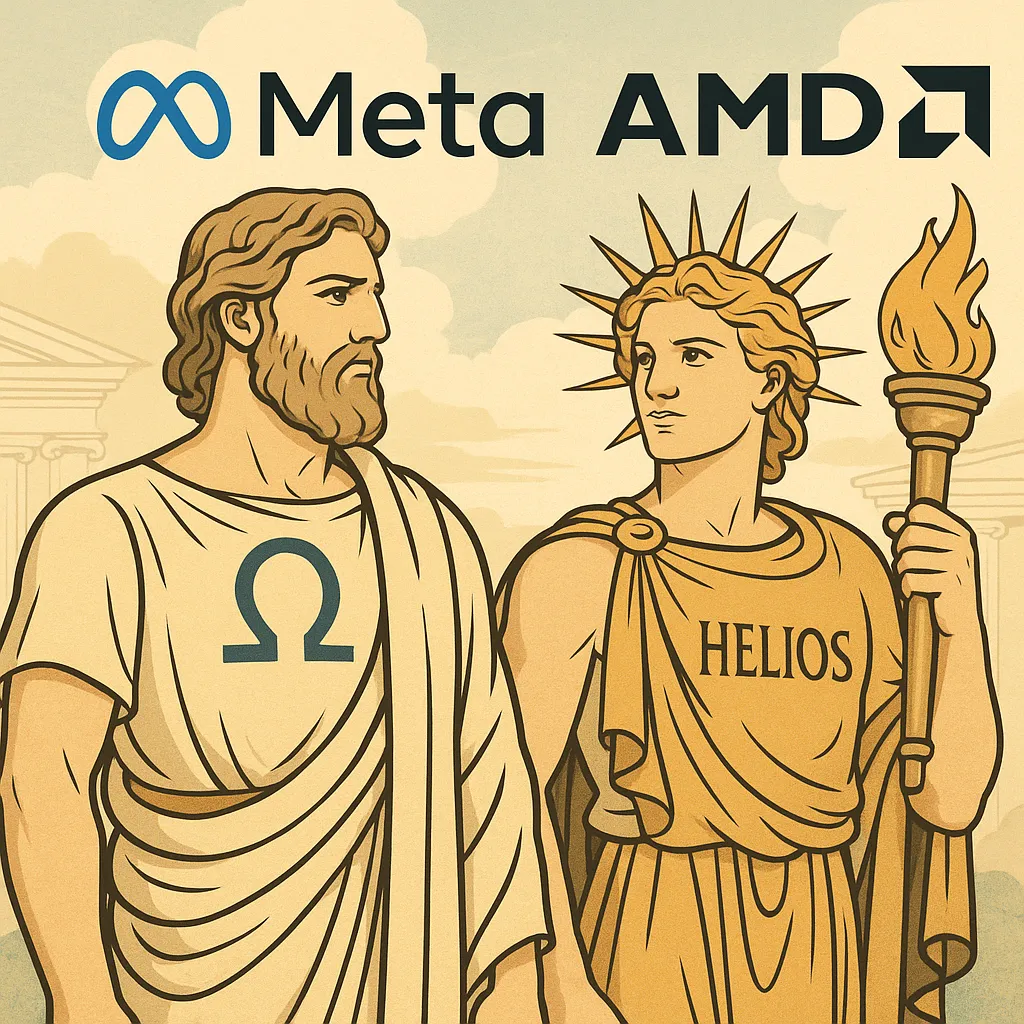
Hyperion is designed as a five-gigawatt class facility expected to come online later in the decade. At that scale, the silicon inside the racks defines the operational envelope of the entire site. Power delivery, cooling topology, and system density become first-order constraints rather than optimization problems.
Helios was designed to fit directly into this reality. AMD built the rack around the Open Rack Wide specification introduced by Meta through the Open Compute Project. ORW expanded rack width to accommodate liquid cooling infrastructure and power bus bars required for accelerators exceeding 1000 watts. Helios aligns with those physical standards by design.
The implication is temporal alignment. AMD’s system design reflects access to Meta’s infrastructure roadmap well in advance of public disclosure. Meta’s cluster planning assumes the availability of rack-scale systems with Helios-class density. This coordination compresses deployment timelines and reduces integration risk across tens of thousands of racks.
At gigawatt scale, symbolic alignment often follows operational dependency. The Helios–Hyperion pairing reflects a shared view of the future compute stack, even in the absence of formal ownership.
Meta’s Incentives for Vertical Integration
Meta’s incentive to pursue ownership of a silicon designer follows directly from the scale implied by Meta Compute.
By early 2026, Meta has framed infrastructure expansion in terms of tens of gigawatts this decade and hundreds of gigawatts over longer horizons. At that scale, compute becomes a national-infrastructure problem rather than a data center optimization exercise. Power generation, transmission, cooling, and hardware efficiency converge into a single system.
Hardware efficiency determines economic output at this level. When facilities consume gigawatts of power, rack-level density dictates how much useful compute can be extracted from a fixed energy envelope. A small improvement in performance per watt compounds across thousands of racks and decades of operation.
Ownership of silicon enables direct co-design between chips and physical infrastructure. Meta could tailor voltage tolerance, packaging, and cooling interfaces to its specific power plants and liquid cooling loops. These optimizations sit below the software layer and cannot be recovered through orchestration or scheduling alone.
Capital structure reinforces the incentive. Meta’s 2025 infrastructure spend was guided to $70–72 billion, with a substantial portion flowing to semiconductor vendors. At merchant pricing, a significant share of that spend represents vendor gross margin. Across multi-year gigawatt build programs, cumulative margin transfer reaches tens to hundreds of billions of dollars. Vertical integration converts that recurring external cost into internalized economics.
Apple’s experience provides a strategic reference point. Control over silicon has allowed Apple to optimize performance per watt in ways unattainable through merchant CPUs. Meta has attempted a parallel path through MTIA, which addresses steady-state inference workloads. Training remains dependent on external accelerators. Acquiring AMD would provide immediate access to a mature GPU architecture and the ROCm software stack, compressing development timelines relative to building a full training platform internally.
These incentives explain why acquisition logic appears coherent when viewed through the lens of gigawatt-scale compute.
The Scale Problem: A Financial Engineering Stress Test
The strategic logic encounters its first hard constraint at transaction scale.
As of mid-January 2026, Advanced Micro Devices carries an approximate market capitalization of $330 billion. Any credible acquisition attempt would require a control premium sufficient to clear shareholder approval. A premium in the 30–40% range implies incremental consideration of roughly $110–130 billion.
That places total deal value near $445 billion.
Meta’s balance sheet does not support a cash transaction of this size. Cash, cash equivalents, and marketable securities total approximately $44–45 billion, covering barely 10% of the implied purchase price. Even a partial cash component would exhaust liquidity and eliminate financial flexibility during a period of elevated infrastructure spending.
Debt financing does not meaningfully close the gap. Raising $100+ billion in corporate debt for a single transaction would likely force a downgrade and materially increase Meta’s cost of capital. In a rate environment structurally higher than the 2010s, interest expense alone would become a non-trivial drag on free cash flow.
That leaves equity issuance as the only viable mechanism.
At a market capitalization near $1.6 trillion, funding $400 billion of consideration through stock would require issuing roughly 600 million new shares at prevailing prices. This equates to dilution on the order of 25% for existing shareholders.
Such dilution introduces a structural conflict. Meta’s shareholder base holds the stock for exposure to high-margin advertising, software leverage, and capital-light economics. Acquiring AMD imports a lower-margin, capital-intensive, cyclical hardware business into the consolidated entity.
The result would be margin compression at the corporate level and the introduction of semiconductor cycle volatility into Meta’s earnings profile. The transaction would shift Meta’s financial identity in a way that is difficult to justify on purely economic grounds, even if long-term infrastructure control were achieved.
At this scale, financial feasibility becomes the dominant constraint.
The Poison Pills: Technical and Legal Blockers
The most severe obstacle sits inside AMD’s legal and architectural foundation.
AMD operates under an x86 cross-license agreement with Intel that governs its ability to design and sell x86 processors. The agreement contains a change-of-control clause that terminates the license if AMD is acquired by another entity. An acquisition by Meta would trigger that clause.
The consequence is immediate. AMD would lose the legal right to produce EPYC server CPUs and Ryzen client processors. The EPYC “Venice” line, which anchors rack-scale systems like Helios and holds meaningful share of the data center market, would become nonviable. A substantial portion of AMD’s revenue base would disappear upon close.
Renegotiation with Intel does not present a realistic path. Intel remains a direct competitor across CPUs and accelerators and has little incentive to preserve AMD’s position under a Meta parent. Any renegotiation would likely involve punitive economics or outright refusal, especially in a period where Intel is fighting to regain relevance in data center compute.
Beyond x86, AMD’s intellectual property stack introduces additional friction. The company relies on a dense web of third-party licenses spanning EDA tools, interconnect IP, memory controllers, and architectural components sourced from firms such as Cadence, Synopsys, and ARM. A change in control triggers renegotiation clauses across many of these agreements.
Untangling those licenses during an acquisition would consume years and introduce execution risk precisely when Meta would require uninterrupted silicon delivery. Semiconductor IP does not transfer cleanly across corporate boundaries, particularly at AMD’s scale.
These poison pills convert theoretical strategic logic into practical infeasibility.
Regulatory Reality: The Antitrust Wall
Even if financial and technical barriers were resolved, regulatory approval would remain prohibitive.
In the United States, the Federal Trade Commission and Department of Justice continue to apply aggressive scrutiny to vertical integration involving dominant platform companies. An acquisition of AMD by Meta would be evaluated under theories of vertical foreclosure. Regulators would argue that Meta would possess both the incentive and ability to restrict access to AMD’s accelerators for competing cloud providers, including Microsoft Azure, AWS, Google Cloud, and Oracle.
AMD represents one of only two viable suppliers of high-performance AI accelerators at scale. Concentrating that supply under a single hyperscaler would be framed as a substantial reduction in competition across both the semiconductor and cloud infrastructure markets.
Recent precedent reinforces this posture. The attempted acquisition of ARM by NVIDIA was challenged on similar grounds, despite ARM’s neutral licensing model and lack of direct cloud competition. A Meta–AMD transaction would face an even higher bar given Meta’s status as a designated gatekeeper platform.
International approval compounds the difficulty. The transaction would require clearance from China’s State Administration for Market Regulation due to both companies’ commercial exposure within China. In the context of ongoing US–China technology tensions, China has limited incentive to approve a deal that strengthens a US hyperscaler’s control over advanced compute infrastructure. Historical precedent suggests prolonged delay or outright rejection.
European regulators present an additional barrier. Under the Digital Markets Act, Meta is subject to heightened scrutiny around any expansion of gatekeeper power. Acquiring a critical semiconductor supplier would be interpreted as extending platform dominance into the physical infrastructure layer, triggering resistance from the European Commission.
Regulatory alignment across jurisdictions would be required for completion. Failure in any single region would be sufficient to collapse the transaction.
Talent and Cultural Incompatibility
Execution risk extends beyond legal and regulatory constraints into organizational reality.
Meta operates on a software development cadence defined by rapid iteration, continuous deployment, and tolerance for post-launch correction. AMD operates on semiconductor design cycles measured in years, where errors discovered after tape-out require costly respins and long delays. These operating tempos do not reconcile cleanly.
Silicon development enforces a discipline built around irreversible decisions. Design errors cannot be patched. Schedule slips cascade across foundry reservations, packaging capacity, and customer delivery commitments. Integrating this culture into an organization optimized for fast-moving software releases introduces persistent friction.
Retention presents an additional challenge. Hardware engineers operate within a specialized labor market and often self-select into firms where silicon design is the primary mission. Absorption into a platform company whose core revenue engine is advertising and software risks morale degradation and attrition. Competing firms would actively recruit AMD engineers during any prolonged acquisition process.
Compensation alignment compounds the issue. Meta’s software compensation bands materially exceed typical semiconductor pay structures. Equalizing compensation across tens of thousands of hardware employees would impose significant cost. Maintaining separate tiers would create internal stratification and accelerate departures.
At AMD’s scale, cultural integration becomes a structural liability rather than a manageable post-merger task.
Virtual Integration as the Dominant Outcome
Meta has already identified a path that captures much of the strategic benefit of ownership without incurring the associated risks.
Rather than acquiring AMD, Meta is positioning itself as a systems integrator with disproportionate influence over upstream design. Through the Open Compute Project, Meta defines physical standards that constrain how silicon must be packaged, cooled, and powered. Open Rack Wide sets the geometry. Power and cooling specifications define the feasible operating envelope. Vendors adapt or lose access to deployment at scale.
Volume commitments reinforce that leverage. Promises of large, multi-year purchase orders allow Meta to influence roadmap decisions without assuming balance sheet exposure. Feature prioritization, memory configurations, and interconnect support follow demand signals tied to guaranteed deployment.
Co-design completes the loop. The Helios rack reflects collaboration that places Meta engineers close to AMD design reviews and system planning cycles. The result resembles internal division behavior while preserving vendor independence.
In parallel, Meta continues to expand internal ASIC development through MTIA for steady-state inference workloads. Merchant silicon remains reserved for frontier training and flexible experimentation. This hybrid approach balances control, redundancy, and execution speed.
Virtual integration delivers most of the benefits of ownership while avoiding financial dilution, regulatory entanglement, and operational disruption.
Extreme Conditions: When the Impossible Becomes Plausible
There are limited scenarios in which a Meta–AMD transaction moves from implausible to actionable. Each requires a breakdown of current structural assumptions.
One path involves a systemic failure within the dominant accelerator supply chain. A catastrophic design flaw, prolonged manufacturing disruption, or collapse of NVIDIA’s platform control could trigger industry-level panic. In such an environment, preserving a second high-performance silicon designer might justify extraordinary measures. Meta could act as a stabilizing acquirer with tacit government support to maintain domestic compute capacity.
A second path involves national security intervention. If sovereign AI capacity is formally designated as a strategic asset, antitrust enforcement could be suspended in favor of consolidation. Under this framework, vertical integration would be reframed as industrial policy rather than market control. Congressional action could override licensing constraints and regulatory objections, clearing barriers that currently render the transaction infeasible.
A third path emerges through structural failure elsewhere in the x86 ecosystem. An Intel bankruptcy or forced breakup could place x86 licensing assets into judicial or governmental control. Acquisition of those rights would neutralize AMD’s most severe poison pill and reopen strategic optionality around ownership.
Each scenario implies conditions well outside normal market operation. They reflect regime change rather than deal-making.
Conclusion: Strategic Possibility Versus Structural Probability
The logic for Meta to acquire AMD is coherent when viewed through the lens of gigawatt-scale compute. Control over silicon would align hardware, power, cooling, and software into a single system optimized for Meta’s long-horizon infrastructure ambitions. At sufficient scale, that logic stops resembling optional strategy and starts resembling industrial planning.
That coherence does not translate into feasibility.
The transaction collapses under its own weight once financial scale, licensing structure, regulatory posture, and organizational reality are applied. A $450 billion acquisition introduces dilution, balance-sheet risk, and margin compression that overwhelms the theoretical efficiency gains. The x86 license termination clause alone converts ownership into immediate value destruction. Antitrust enforcement across the United States, Europe, and China erects barriers that cannot be arbitraged away. Cultural and talent integration risk compounds execution uncertainty at precisely the moment Meta would require operational stability.
The result is a sharp distinction between desire and outcome.
Meta does not need to own AMD to achieve strategic control. Through standard setting, volume commitments, and co-design, it already exercises influence over AMD’s roadmap while preserving vendor independence. The Helios–Hyperion alignment illustrates how deeply this virtual integration can extend without triggering structural poison pills. Meta secures capacity, flexibility, and leverage while avoiding dilution, regulatory deadlock, and organizational drag.
For AMD, this relationship reinforces its position as a foundational supplier within the AI infrastructure stack. Its value does not rest on acquisition optionality. It rests on necessity. Hyperscalers require AMD to exist, scale, and compete in order to prevent single-vendor dependency at national-infrastructure scale.
The takeaway is not about M&A.
It is about power.
The next decade of AI will be governed less by who owns the chips and more by who can secure the energy, define the systems, and coordinate silicon at gigawatt scale. Meta is becoming an infrastructure integrator. AMD is becoming an infrastructure engine. Their paths remain aligned without convergence.
That alignment, not ownership, is the durable equilibrium.
Want the full AMD roadmap and valuation framework?
Our premium AMD research goes deeper into long-horizon scenarios, rack-scale economics, and probability-weighted outcomes through 2030. Premium members receive full access to our AMD modeling work and the complete Northwise research library.
AMD Revenue per Gigawatt: What the Hardware Is Worth
How much revenue can AMD earn per gigawatt? We examine GPU pricing, EPYC, Helios component content, delivery costs and the assumptions in our financial model.
AMD Stock Forecast 2030
This AMD Stock Forecast 2030 explores AMD's transition from a distant secondary supplier to an open compute superpower in Artificial Intelligence.
AMD Sovereign AI Infrastructure
AMD sovereign AI: live HUMAIN systems, future Saudi capacity, LUMI-AI procurement, Korea's partnership and the path from infrastructure plans to revenue.
Northwise Portfolios
See how the research becomes real decisions
Reader discussion
Discuss the research
Create a Free account to join the discussion with a display name.
Create a Free Account
No comments yet. Start a thoughtful discussion.